
The word plangud may look unfamiliar if you encounter it while browsing websites, reading translated product descriptions, or researching building materials. Its meaning becomes much clearer when you understand the language and context in which it appears. In Estonian, plangud is the plural form of plank, a word associated with wooden planks and thick boards. However, some online articles use the same term to discuss planning, organization, and productivity. This guide explains the established meaning of plangud, its uses in woodworking and construction, and how to distinguish its dictionary definition from newer interpretations found online.
What Does Plangud Mean?
Plangud is an Estonian word that translates into English as “planks” or “wooden boards.” It refers to multiple pieces of wood rather than one specific product, company, or brand.
The underlying Estonian word, plank, refers to a relatively thick wooden board. The Estonian explanatory dictionary describes the term in connection with thick boards and wooden fences.
Depending on the sentence, a natural English translation may be “wooden planks,” “thick boards,” or “timber boards.” The best choice depends on the material being described and its intended purpose.
For example, a timber supplier might use the term when listing pieces of wood for construction, while a furniture maker might use it in a discussion about boards selected for a table or bench.
The important point is that plangud has a clear linguistic meaning in Estonian, even though its appearance on the internet can sometimes create confusion.
Is Plangud a Product, Brand, or Digital Platform?
A search for plangud may lead to several different kinds of web pages. Some discuss timber and construction materials, while others describe a planning framework, productivity method, or digital concept.
These meanings should not automatically be treated as equivalent.
The wooden-plank interpretation is supported by Estonian dictionary material. By contrast, the planning-related descriptions appear in newer online content and should not be mistaken for an established dictionary definition or proof of a widely recognized software product.
If you encounter Plangud as the name of an application or business, examine the particular website or company’s documentation. Look for an identifiable publisher, clear product information, working contact details, and specific explanations of the services offered.
Similarly, if you encounter the word in a translated timber catalogue, read the surrounding description to determine the material, dimensions, and intended application.
Understanding the context is the easiest way to avoid confusing a common material term with a name chosen by an online publisher.
How Are Plangud Used in Construction?
Wooden planks are versatile materials used in building, carpentry, and numerous practical projects. Their suitability depends on factors such as wood species, dimensions, moisture content, surface preparation, and the demands of the intended application.
1. Building and Carpentry
Planks can be cut and shaped into components for general building and carpentry work. Depending on their specifications, they may be used for work surfaces, simple structures, supports, or other wooden assemblies.
Not every plank is suitable for structural construction. Projects requiring load-bearing materials need timber with appropriate dimensions, strength grading, and documentation.
Before selecting wood for a building project, establish whether the material is intended for structural or nonstructural use.
2. Fences and Garden Projects
Wooden planks can be used to construct fences, gates, garden screens, and other outdoor features.
Their appearance can complement gardens and outdoor spaces, particularly when the design emphasizes natural grain and texture. However, wood exposed to rain, changing temperatures, and ground moisture requires suitable material selection and protection.
Buyers should check whether the timber is appropriate for outdoor exposure and whether any preservative treatment is suitable for the intended use.
3. Furniture and Interior Design
Furniture makers often select wooden planks for their grain patterns, thickness, and overall appearance. Suitable boards may be processed into tabletops, benches, shelves, cabinets, and decorative interior features.
Different pieces of timber have different characteristics. Some display prominent knots and irregular grain, while others offer a more consistent appearance.
The right choice depends on the desired design, available working dimensions, and performance requirements.
For instance, a rustic table may benefit from visible grain variations, while a fitted cabinet may require straighter, more uniform material.
4. Flooring and Decking
Wood is also used for floors, steps, platforms, and decking when the material has the appropriate specifications.
However, the word plangud alone does not establish that a board is suitable for flooring or decking. Buyers need to consider thickness, strength, surface finish, moisture conditions, durability, and installation requirements.
Exterior decking faces different environmental challenges from indoor flooring. Choosing material based solely on appearance can therefore lead to problems later.
5. Marine and Specialized Woodworking
Wooden planks also have specialized applications, including certain forms of boatbuilding and marine repairs.
These projects require careful consideration of wood species, grain, moisture, fastening methods, and the design of the finished assembly.
A standard building plank should not automatically be treated as suitable for marine applications. The appropriate material depends on the particular project and its technical requirements.
Different Types of Wooden Planks
Although plangud is a plural noun rather than a specific wood classification, timber products can be described in several useful ways.
| Timber description | General characteristics | What to consider |
|---|---|---|
| Rough-sawn planks | Surfaces may retain saw marks and irregularities | Allowance for cutting and surface preparation |
| Planed planks | Smoother surfaces and more consistent finished dimensions | Actual thickness, width, and edge condition |
| Kiln-dried timber | Dried under controlled conditions | Moisture level and suitability for the destination |
| Air-dried timber | Dried naturally over time | Current moisture content and drying condition |
| Treated timber | Preservatives or other treatments may have been applied | Treatment type and permitted applications |
| Untreated timber | Supplied without the represented preservative treatment | Natural durability and protection requirements |
These descriptions are not interchangeable. A plank can be planed and treated, for example, or rough-sawn and kiln-dried. Check the supplier’s specifications instead of assuming that one label tells you everything about the wood.
How to Choose the Right Wooden Planks
Selecting suitable timber requires more than checking its price or appearance. A few basic checks can help you determine whether the material matches your project.
Check the Dimensions
Measure the length, width, and thickness of the boards. Where precise fitting matters, confirm the finished dimensions rather than relying only on nominal measurements.
Also consider whether cutting, planing, or other preparation will reduce the usable dimensions.
Identify the Wood Species
Different wood species have different characteristics, including weight, strength, grain appearance, resistance to decay, and ease of machining.
Softwoods may be suitable for a variety of general construction projects, while particular hardwoods may be preferred for certain furniture or decorative applications. Neither category guarantees that every board is suitable for every job.
Ask the supplier to identify the species or standardized trade name when the distinction matters.
Inspect for Defects
Look along the board for excessive bending, twisting, or warping. Examine both faces, the edges, and the ends for splits, deep cracks, loose knots, or signs of decay.
Some imperfections are mainly cosmetic. Others can affect strength, stability, or the amount of material that can be used.
The importance of each defect depends on the application.
Consider Moisture Content
Wood naturally gains and loses moisture as its surrounding conditions change. These changes can cause it to expand or shrink, particularly across the grain.
This is important for furniture, flooring, decking, and other projects that require accurate dimensions. Timber that has not adjusted to its intended environment may move after installation.
For demanding projects, ask about moisture specifications and follow relevant installation guidance.
Compare More Than the Purchase Price
Two suppliers may offer boards that appear similar but differ in dimensions, wood species, grading, treatment, or preparation.
Compare the specifications, quantity, usable dimensions, delivery costs, and suitability for the project. The lowest initial price is not necessarily the best overall value if the timber requires extensive additional work or fails to meet the project’s requirements.
Why Does Plangud Have Different Meanings Online?
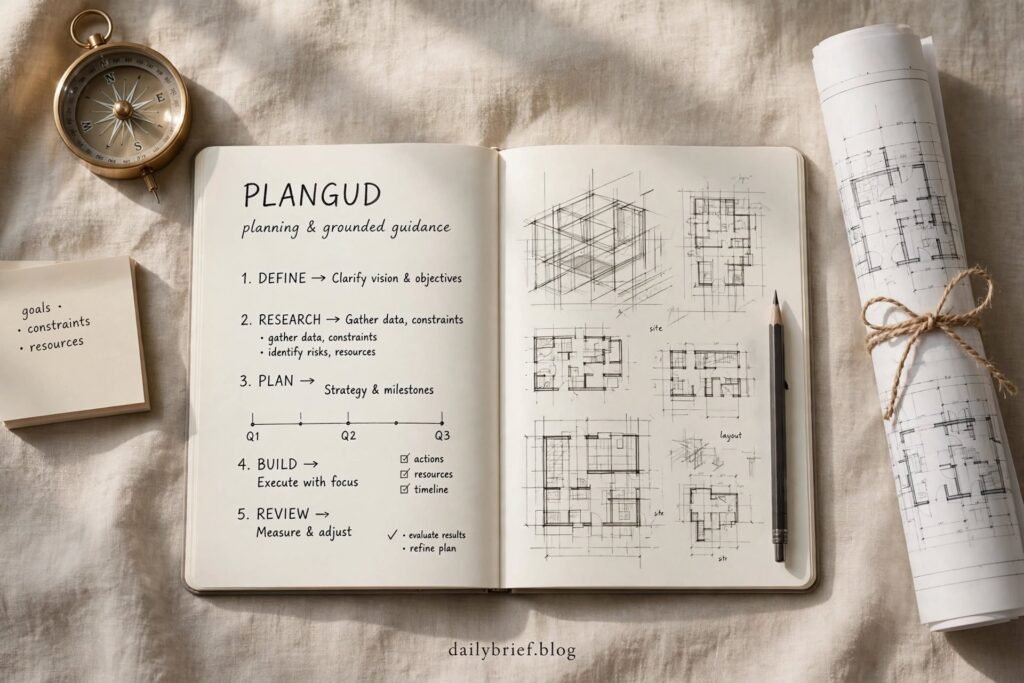
The internet frequently brings words from different languages, industries, and communities into the same search results. That is one reason an unfamiliar term may appear to have several definitions.
Plangud is a useful example.
In its established Estonian usage, the word refers to planks. In some English-language online articles, it is also presented as a productivity concept or planning-related platform. These uses should be evaluated separately rather than combined into a single assumed definition.
The surrounding vocabulary can help you determine which meaning is relevant.
If a page discusses timber, sawmills, furniture, fences, or construction, the wooden-plank meaning is likely intended. If it discusses goals, tasks, project management, or productivity software, the publisher may be using Plangud as a name or developing a newer interpretation.
The distinction matters because repeating an online description does not make it an established linguistic or technical fact.
When accuracy is important, consult a reputable dictionary for the language meaning and the original publisher for claims about a specific product or service.
Common Mistakes When Interpreting Plangud
Several misunderstandings can arise when people encounter the word for the first time.
Assuming it is an English word: Plangud is an Estonian word form, so its meaning is best understood through Estonian vocabulary and grammar.
Treating every online definition as authoritative: Articles may use the term differently. Check whether a definition is supported by linguistic evidence or is simply an interpretation offered by a particular website.
Assuming it identifies a specific product: The ordinary timber meaning refers to multiple planks, not one particular manufacturer or product model.
Ignoring context: A translated construction listing and an article about digital productivity may use the same word for different reasons.
Assuming all wooden planks are suitable for the same job: Material specifications, treatment, dimensions, and environmental conditions determine the appropriate application.
These distinctions make it easier to understand the word accurately and avoid unsupported assumptions.
Frequently Asked Questions About Plangud
What does plangud mean in English?
Plangud is the Estonian plural form of plank and generally translates as “planks” or “wooden boards.” The precise wording depends on the context in which it appears.
Is plangud an Estonian word?
Yes. It is an Estonian noun form associated with wooden planks and boards. It can appear in discussions about timber, carpentry, construction, and other applications involving wood.
Is Plangud a planning app?
Some websites describe Plangud as a planning or productivity concept. However, those descriptions should not be treated as proof of an established, widely recognized application. Verify the particular product’s official documentation before relying on its claimed features.
What are wooden planks used for?
Depending on their specifications, wooden planks may be used for construction, fencing, furniture, flooring, decking, decorative interiors, and specialized woodworking. Structural or outdoor applications require suitable material and proper installation.
How do I choose good-quality wooden planks?
Check the wood species, dimensions, moisture content, surface condition, visible defects, and intended application. For structural projects, verify the relevant grading and technical requirements rather than relying on appearance alone.
Is plangud the name of a specific wood type?
No. The word itself does not identify a particular wood species. The type of timber must be established from the product description or supplier’s specifications.
Conclusion
Plangud is an example of how an unfamiliar search term can become confusing when dictionary meanings and newer online interpretations appear side by side. Its established Estonian meaning is connected with wooden planks and boards, making it relevant to timber, carpentry, construction, furniture, and related subjects.
Understanding the surrounding context is essential. A dictionary can clarify the linguistic meaning, while product specifications can explain whether a particular plank is suitable for a practical project. Likewise, claims about a website or digital service should be checked against the publisher’s own documentation.
For readers researching plangud, the most useful approach is to start with the established meaning, examine the context, and verify any additional claims before accepting them as fact.