Introduction
Data consistency is essential when information comes from multiple sources, contains different naming conventions, or follows inconsistent formats. The phrase brandrank.ai normalization transformation rules raises an important question: how can raw data be cleaned, standardized, and converted into a consistent structure that systems can process reliably?
Normalization and transformation are closely related, but they are not identical. Normalization typically brings values into a consistent format or scale, while transformation changes data into a structure or representation suited to a particular purpose. Together, these processes can make information easier to compare, organize, analyze, and maintain.
For example, a dataset might contain a company name as “ABC Technologies,” “ABC Tech,” and “A.B.C. Technologies.” Depending on the purpose of the dataset, these entries may refer to the same organization. A normalization process can standardize their formatting, while a separate entity-matching rule can determine whether they should be treated as one entity.
Understanding these distinctions is useful for SEO professionals, marketers, developers, data analysts, and anyone working with brand information or structured datasets. This guide explains normalization and transformation rules, illustrates common techniques with practical examples, explores potential errors, and outlines a repeatable workflow for improving data quality.
One important distinction remains throughout: the examples are general implementation patterns, not confirmed rules or features of Brandrank.ai’s proprietary systems.
4. What Are Brandrank.ai Normalization Transformation Rules?
The term can be understood as a practical approach to standardizing brand-related information and converting it into a structure suitable for analysis. In an AI search visibility context, this might involve recognizing brand-name variations, organizing product information, identifying citations, and recording how brands appear in generated answers.
However, there is an important distinction between a useful industry concept and an official product specification. BrandRank.AI’s public website describes a platform focused on AI search visibility, brand vulnerability, and content readiness, but the public materials reviewed do not establish a formally documented feature named “normalization transformation rules.” AI Brand Monitoring & Recommendation Share™+1
Therefore, the rules discussed in this article are general data-management recommendations that can be applied to brand analysis. They should not be mistaken for BrandRank.AI’s proprietary algorithms or unpublished technical documentation.
Understanding normalization
Normalization makes equivalent data consistent without unnecessarily changing its meaning.
For example, the following strings may represent the same company:
- BrandRank.AI
- BrandRank AI
- brandrank.ai
- BRANDRANK.AI
A normalization process can standardize capitalization and formatting. If the records refer to the same verified organization, an entity-matching process can then associate them with one canonical brand record.
Normalization should not automatically merge every similar name. Two organizations can have similar names while remaining separate businesses.
Understanding transformation
Transformation converts information into a different format, structure, or representation for a specific purpose.
For example, a paragraph generated by an AI answer engine could be transformed into structured fields showing whether a brand was mentioned, which product was discussed, whether a source was cited, and what claims require verification.
IBM’s overview of data transformation explains how these processes help prepare raw information for integration, analysis, and use across systems. IBM
5. Normalization vs. Transformation: Key Differences
Although the terms are closely connected, they solve different problems.
| Aspect | Normalization | Transformation |
|---|---|---|
| Main purpose | Standardize values or representations | Convert data into a useful format or structure |
| Typical input | Inconsistent names, dates, URLs, or categories | Raw text, records, files, or datasets |
| Typical output | Consistent values or canonical identifiers | Structured records or transformed datasets |
| Example | Mapping verified brand-name variants to one entity | Extracting brand mentions from AI-generated text |
| Main risk | Merging distinct entities incorrectly | Losing information or changing meaning |
| Validation | Check consistency and matching accuracy | Check output structure, completeness, and correctness |
Consider a company that appears in five different reports under slightly different names. Normalization helps determine which variations should share a canonical identity. Transformation can then combine the relevant records into a report that compares the company’s visibility across different sources.
The two processes are complementary, but neither replaces the need to verify the underlying information.
6. Common Normalization Rules for Brand Data
The following rules provide a practical starting point for businesses managing brand information, SEO data, and AI-generated search observations.
Rule 1: Establish a canonical brand name
Choose one preferred name for internal reporting and document legitimate alternatives.
For example:
| Original value | Possible normalized value |
|---|---|
| Example Tech | Example Tech |
| EXAMPLE TECH | Example Tech |
| Example-Tech | Example Tech |
| Example Technologies Ltd. | Review before mapping |
The final example requires special care. A legal company name may be related to a brand without being interchangeable with it.
Best practice: Maintain the official public-facing name, legal name, and known aliases as separate fields when they serve different purposes.
Rule 2: Standardize capitalization, spacing, and punctuation

Inconsistent formatting can create unnecessary variations in a dataset.
Common cleanup operations include:
- Removing accidental leading and trailing spaces.
- Standardizing repeated whitespace.
- Applying a consistent capitalization policy.
- Normalizing punctuation when it does not distinguish separate entities.
- Handling Unicode characters consistently.
For instance, Example Tech could be cleaned to Example Tech.
However, punctuation should not always be removed. A dot, hyphen, or other character may be an important part of a brand’s official name or domain.
Rule 3: Normalize URLs without losing important distinctions
The same website may appear with different URL formats, such as:
http://example.comhttps://example.comhttps://www.example.com/
A data pipeline can standardize URL formatting and resolve known aliases to a preferred domain when appropriate.
Before merging URLs, verify redirects, canonical tags, subdomains, and site ownership. Different subdomains may represent separate products or regional sites, so they should not automatically be treated as duplicates.
Rule 4: Keep product names and brand names distinct
A company and its products should not be treated as the same entity simply because their names are related.
For example, a dataset might contain:
- Company: Example Audio
- Product: Example Audio Studio
- Product: Example Audio Mini
- Product category: Wireless speakers
A useful data model assigns each item its own identity and links products to the appropriate brand.
This helps prevent product mentions from being incorrectly counted as company mentions.
Rule 5: Standardize categories with a controlled vocabulary
Different data sources may describe the same general topic using different labels.
| Source label | Possible standardized category |
|---|---|
| Online advertising | Digital marketing |
| Internet marketing | Digital marketing |
| SEO consulting | Search engine optimization |
| Search optimization | Search engine optimization |
These mappings should be based on clear definitions rather than superficial wording.
If two labels describe different services, retain the distinction instead of forcing them into one category.
Rule 6: Detect duplicates carefully
Duplicate detection identifies records that may represent the same underlying entity.
Exact duplicates are relatively straightforward. Near-duplicates require more context.
For example, two records might share a company name but have different domains, countries, or product lines. Automatically merging them could corrupt the dataset.
Use a combination of evidence, such as official domains, stable identifiers, company addresses, and verified aliases. When evidence is insufficient, flag the records for manual review.
Rule 7: Preserve the original information
A reliable normalization workflow should retain the source value alongside the cleaned value.
For example:
| Field | Value |
|---|---|
| Original name | BRANDRANK.AI |
| Normalized display name | BrandRank.AI |
| Canonical entity ID | brand_001 |
| Match status | Verified |
| Source | Original dataset |
This structure makes it possible to investigate errors and reverse a transformation when necessary.
It also helps teams distinguish the information originally collected from the interpretation applied during processing.
7. Transformation Rules for AI Search Visibility Data
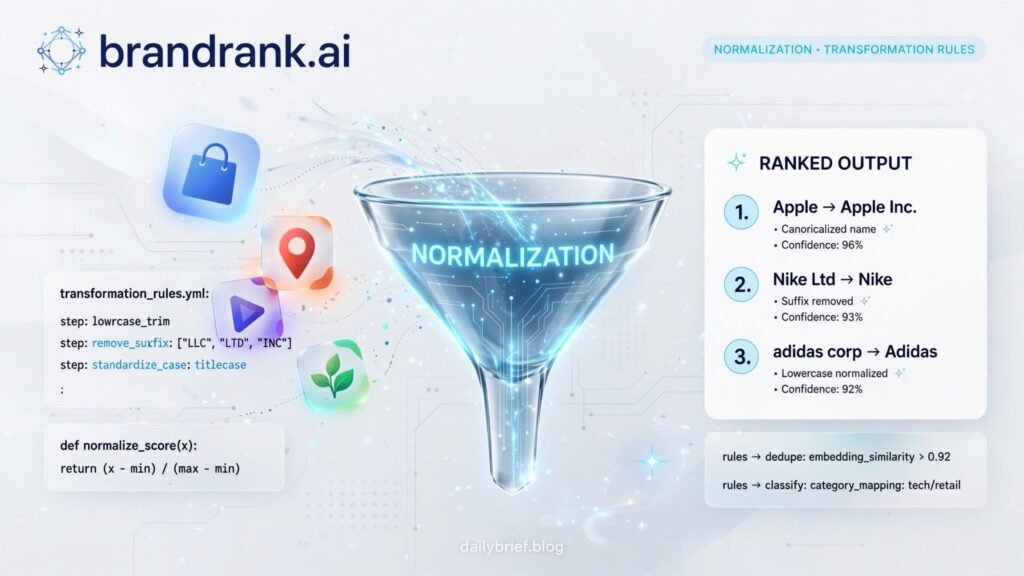
Once brand information is standardized, transformation can make raw observations more useful for reporting and analysis.
These examples describe a possible workflow for an AI visibility project, not confirmed BrandRank.AI internal processes.
Rule 1: Convert unstructured answers into structured records
An AI-generated answer may contain multiple brands, product descriptions, and source references in a single paragraph.
A transformation pipeline can extract relevant information into separate fields.
For example, consider this illustrative answer:
Example Coffee is a popular option for iced coffee, while Sample Roasters offers several alternative blends.
A structured record might look like this:
| Field | Example value |
|---|---|
| Mentioned brand | Example Coffee |
| Product category | Coffee |
| Context | Iced coffee |
| Competitor mentioned | Sample Roasters |
| Recommendation status | Requires contextual review |
| Source citation | Not provided in this example |
The recommendation status requires review because mentioning a brand is not necessarily the same as explicitly recommending it.
Rule 2: Separate mentions from citations
A brand mention occurs when an answer names a brand. A citation occurs when the answer references a source, usually through a link or another identifiable reference.
These are different measurements.
For example, an AI answer might name a company without linking to its website. Conversely, it might cite an industry report that discusses the company.
Tracking both separately helps prevent misleading conclusions about brand visibility and source attribution.
Rule 3: Apply consistent sentiment labels
Sentiment analysis attempts to classify the tone or opinion expressed in a piece of text.
A practical classification system might include:
- Positive
- Neutral
- Negative
- Mixed
- Unclear
Consider the sentence: “Example Tech offers useful features, but its customer support is unreliable.”
A single positive or negative label would lose important context. A mixed classification, supported by the original text, may be more appropriate.
Automated sentiment classification can make mistakes, particularly with sarcasm, technical language, comparisons, and statements that combine several claims. Human review is advisable for consequential decisions.
Rule 4: Record claims separately from verified facts
AI-generated answers may contain outdated or inaccurate statements. A reporting system should not automatically treat generated content as established truth.
A useful workflow records:
- The exact claim.
- The source in which it appeared.
- The date it was observed.
- The evidence available to verify it.
- The review status.
- Any corrective action taken.
This makes it easier to investigate inaccurate brand descriptions without confusing an AI-generated statement with a verified fact.
Rule 5: Standardize dates, markets, and languages
Comparisons become unreliable when records use inconsistent dates or mix different markets without appropriate labels.
For example, a report should distinguish a brand mention found in an English-language answer for the United States from one found in a French-language answer for France.
Useful metadata includes:
- Observation date and time zone.
- Country or market.
- Language.
- AI answer engine.
- Prompt or query.
- Model or version, when available.
- Processing-rule version.
These fields help explain why results differ between observations.
8. A Step-by-Step Normalization and Transformation Workflow
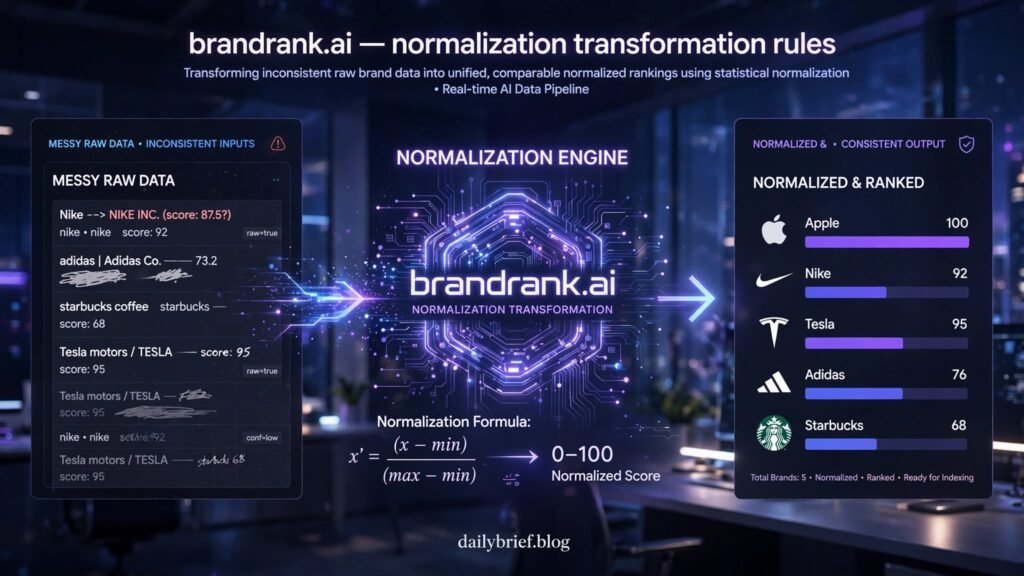
A consistent workflow makes data processing easier to audit, repeat, and improve. The following process can be adapted to brand monitoring, SEO reporting, competitor analysis, and AI search visibility research.
Step 1: Collect raw data
Gather brand names, website URLs, product information, AI-generated answers, citations, and other relevant observations. Record each source and its collection date.
Step 2: Profile the data
Identify missing values, inconsistent formats, duplicate records, unexpected characters, and conflicting brand identities.
Step 3: Apply normalization rules
Standardize appropriate fields and map verified aliases to canonical identifiers. Keep ambiguous matches separate until they can be checked.
Step 4: Transform the data
Convert cleaned information into the required schema, such as structured brand mentions, citation records, competitor comparisons, and review flags.
Step 5: Validate the results
Check field types, required values, entity matches, record counts, and whether the transformed output preserves the meaning of the source.
Step 6: Monitor and update
Review errors, update aliases when brands change, document rule revisions, and rerun validation after significant changes.
IBM’s published explanation of data transformation also describes discovery, cleaning, mapping, execution, validation, and review as parts of a practical transformation workflow. IBM
Example: From raw observations to a useful report
Imagine an analyst collects 100 AI-generated answers about a particular product category. The brand appears under different spellings, some answers mention competitors, and only some include citations.
A sensible process would be to:
- Preserve all 100 original answers.
- Identify verified brand-name variations.
- Normalize the records without merging unrelated businesses.
- Extract mentions and citations into separate fields.
- Flag uncertain matches and claims for review.
- Calculate metrics from validated records.
- Document the filters and rules used to produce the report.
The result is a more transparent dataset. It does not automatically mean that the brand will receive more AI recommendations; it means the analysis is less likely to be distorted by inconsistent data.
9. Common Errors and How to Avoid Them
Normalization is not simply a matter of removing punctuation or converting every value to lowercase. Poorly designed rules can destroy meaningful distinctions.
| Common mistake | Why it causes problems | Better approach |
|---|---|---|
| Merging similar company names | Different companies may be confused | Verify domains, identifiers, and other evidence |
| Removing all punctuation | Official names may change meaning | Apply field-specific formatting rules |
| Treating every mention as a recommendation | Visibility metrics become misleading | Classify the surrounding context |
| Treating every cited page as a brand endorsement | A source may discuss a brand critically | Review the source and statement |
| Replacing original data | Errors become harder to investigate | Keep raw and normalized values |
| Ignoring dates and markets | Comparisons may mix different conditions | Store observation metadata |
| Assuming automated sentiment is always correct | Context and sarcasm may be missed | Use confidence flags and human review |
| Treating structured data as a ranking guarantee | Expectations become unrealistic | Follow official search documentation and measure outcomes |
Why over-normalization is dangerous
Over-normalization happens when rules simplify data so aggressively that distinct entities or meanings disappear.
For example, two products may have almost identical names but different capacities, versions, or regional availability. Removing every number and punctuation mark could cause them to become indistinguishable.
The goal should be consistent representation without loss of important meaning. A good rule standardizes only what can safely be standardized.
10. How Normalization Relates to SEO and AI Search
Consistent brand information can support SEO operations by making it easier to manage company names, product details, content references, and reporting data. However, several related concepts should not be confused.
Consistent branding across the web
Using a recognizable name, accurate business information, and consistent descriptions helps readers understand which organization a page represents.
When appropriate, maintain consistent details across:
- The official website.
- Author and company profiles.
- Relevant business directories.
- Product pages.
- Press releases.
- Third-party references.
Consistency should never come at the expense of accuracy. Update outdated information rather than repeating an incorrect claim simply because it appears in multiple places.
Structured data and machine-readable information
Structured data provides explicit information about the content of a page. Depending on the page, appropriate markup may describe an organization, a product, an article, or another supported entity.
Google Search Central recommends that structured data accurately represent visible page content and follow its technical and quality guidelines. It also makes clear that valid structured data does not guarantee a rich result. Google for Developers+1
For a business website, useful steps include:
- Use an appropriate Schema.org type.
- Provide accurate names and URLs.
- Keep markup consistent with visible page content.
- Validate the markup with Google’s testing tools.
- Correct errors and update outdated properties.
Structured data is not the same as normalization. It is a way to describe information in a defined format, whereas normalization establishes consistency among values and representations.
AI visibility measurement
Brand monitoring across AI answer engines may involve measuring mentions, recommendations, citations, accuracy, and competitor presence. BrandRank.AI publicly describes capabilities related to AI search visibility, brand vulnerability, and content readiness. AI Brand Monitoring & Recommendation Share™
Clean data can improve the reliability of the reporting process. Nevertheless, normalization alone does not establish how an AI engine selects sources or generates recommendations, and it cannot guarantee better visibility.
11. How to Measure the Quality of Your Rules
Normalization rules should be assessed by their actual results rather than by how simple they look.
Useful quality checks include:
| Metric or check | What it helps identify |
|---|---|
| Duplicate rate | How many records appear to repeat existing information |
| Match precision | How often accepted entity matches are correct |
| Match recall | How many legitimate matching records are successfully identified |
| Missing-value rate | How often important fields are absent |
| Validation error rate | How frequently records fail required checks |
| Manual review rate | How often the system cannot safely resolve a record |
| Source traceability | Whether transformed values can be linked to their origins |
For entity matching, precision and recall are especially useful. High precision means fewer incorrect merges among accepted matches. High recall means fewer legitimate matches are missed.
Neither metric should be optimized in isolation. A system that merges every vaguely similar name might achieve high recall while producing many false matches. A system that accepts only exact matches might achieve high precision but miss legitimate aliases.
Set acceptance criteria based on the consequences of an error, and test rules against a representative sample of real records before deploying them broadly.
12. Practical Recommendations for Better Results
If you are applying normalization transformation rules to an SEO or AI visibility project, use the following checklist as a starting point.
Data quality checklist
0 of 8Define canonical brand names and verified aliases.Keep original values alongside normalized values.Separate brand, company, product, and location records.Store source URLs, dates, markets, and languages.Distinguish brand mentions from citations and recommendations.Review uncertain matches before merging records.Validate transformed output against the original source.Document rule changes and monitor recurring errors.
What to avoid
- Do not claim that a proprietary platform uses a specific rule unless its documentation confirms it.
- Do not assume that identical-looking names always refer to the same organization.
- Do not remove useful context to make a dataset appear cleaner.
- Do not use normalization as a substitute for checking facts against reliable sources.
- Do not promise improved rankings or AI citations solely because data has been standardized.
For teams using a commercial platform, the safest approach is to consult its official documentation or support team for details about supported exports, available fields, and the interpretation of its metrics.
13. Frequently Asked Questions
1. What are Brandrank.ai normalization transformation rules?
The phrase describes a practical concept involving the standardization of brand information and conversion of raw data into structured records. BrandRank.AI’s public materials reviewed for this article do not establish an official feature or technical specification under that exact name.
2. Is BrandRank.AI normalization transformation a verified official feature?
No such feature was verified in the public materials reviewed. BrandRank.AI describes its AI search visibility, brand vulnerability, and content readiness capabilities, but its proprietary normalization rules should not be assumed without official documentation. AI Brand Monitoring & Recommendation Share™+1
3. What is the difference between normalization and transformation?
Normalization standardizes values or identifies consistent representations of the same entity. Transformation converts data into another format or structure for processing, reporting, or analysis.
4. Why is brand data normalization important?
It can reduce duplicate records, improve consistency, and make comparisons more reliable. It also helps teams distinguish genuine brand mentions from variations caused by inconsistent formatting.
5. Can normalization improve AI search visibility?
Normalization can improve the quality of the data used to measure visibility and investigate inconsistencies. It does not guarantee that an AI system will mention, recommend, or cite a particular brand.
6. How can I normalize brand names correctly?
Start with the official brand name, document verified aliases, retain original values, and use reliable identifiers such as official domains where appropriate. Review ambiguous matches instead of merging them automatically.
7. Does structured data replace normalization rules?
No. Structured data describes information using a defined vocabulary and format. Normalization addresses consistency among values and records. Both can be useful, but they serve different purposes.
8. How often should normalization rules be reviewed?
Review them whenever important brand information changes, new data sources are introduced, or recurring errors appear. For ongoing monitoring, schedule regular validation and keep a record of changes so that earlier results remain interpretable.
14. Conclusion
Understanding brandrank.ai normalization transformation rules starts with separating the general principles of data quality from the features a specific platform has officially documented. Normalization creates consistent representations of brand information, while transformation converts that information into useful structures for analysis.
By standardizing verified names, preserving original records, resolving entities carefully, and validating transformed data, businesses can build more dependable SEO and AI visibility reports. Accurate structured data and consistent brand information can support this work, but neither guarantees improved search rankings or AI recommendations.
The best next step is to establish a documented set of rules, test them against real data, and review the results regularly. For platform-specific functionality, rely on BrandRank.AI’s official resources rather than assumptions about its internal technology.