Introduction
The Elizabeth Fraley Kinder Ready court case has attracted online attention because it connects an early childhood education business with reported civil litigation in California. People searching for information about the case generally want to understand who Elizabeth Fraley is, what the lawsuit involved, how the proceedings ended, and whether a court made any findings against the parties.
Secondary legal reporting describes a civil defamation lawsuit filed in Los Angeles County in October 2023 involving Elizabeth Fraley, Kinder Ready, Inc., and other individuals. The case was reportedly dismissed without prejudice in November 2023, making its procedural outcome an important part of the story.
However, understanding the Elizabeth Fraley Kinder Ready court case requires separating reported legal events from allegations that were never established through a final judgment. A lawsuit records a dispute and the claims made by the parties; it does not automatically prove those claims are true.
This article examines the available reporting, explains the relevant legal terminology, and outlines how readers can verify the information through official court records.
Who Is Elizabeth Fraley?
Elizabeth Fraley is associated with Kinder Ready, Inc., an education business focused on preparing young children for school. According to the organization’s public materials, Fraley founded the business to provide educational support for children developing foundational academic and school-readiness skills.
Kinder Ready describes its services as including individualized instruction, readiness assessments, and preparation for private-school admissions. These services are intended to help children build skills that may support their transition into formal education.
The organization operates in the early childhood education sector, where parents often seek personalized support for literacy, mathematics, communication, and classroom routines.
Understanding this background helps explain why legal developments involving the organization may interest parents, educators, and people researching the company’s professional history.
Nevertheless, a reported legal dispute should be considered separately from an assessment of educational services. Information about litigation alone cannot establish whether a program is effective, whether its teaching methods are appropriate, or whether families should use its services.
What Was the Elizabeth Fraley Kinder Ready Court Case About?
The Elizabeth Fraley Kinder Ready court case refers to a reported civil lawsuit filed in Los Angeles County Superior Court in October 2023. Secondary legal summaries identify Elizabeth Fraley, John James Chalpoutis, and Kinder Ready, Inc. as plaintiffs, with Bobak Morshed and Meline Morshed named as defendants. The reported case number is 23SMCV04480.
According to those summaries, the lawsuit concerned allegations of defamation connected with social media communications. The plaintiffs reportedly alleged that communications attributed to an account using the name “Olivia Wilson Haydon” harmed their reputations.
These descriptions must be treated carefully. The allegations represent claims attributed to the plaintiffs, not findings that a judge or jury necessarily accepted as true.
Defamation generally concerns false statements of fact communicated to someone other than the person targeted, where the applicable legal requirements for reputational harm and fault are satisfied. The precise elements and available defenses depend on the circumstances and governing law.
In this case, the available secondary reporting does not establish that the court reached a final decision on whether the alleged statements were defamatory.
That distinction is central to understanding the Elizabeth Fraley Kinder Ready court case accurately. The filing of a complaint confirms that a legal claim was brought, but it does not independently prove the allegations contained in that complaint.
Timeline of the Elizabeth Fraley Kinder Ready Court Case
The reported timeline provides context for how the litigation progressed and ended. The dates below come from secondary legal summaries and should be checked against the official docket for confirmation.
| Date | Reported development | Significance |
|---|---|---|
| October 9, 2023 | Civil complaint reportedly filed | The legal dispute entered the court system. |
| October 11, 2023 | Case-management notice reportedly issued | A procedural step was scheduled. |
| November 2, 2023 | Service of process reportedly documented | The defendants were reportedly served. |
| November 27, 2023 | Voluntary dismissal reportedly requested | The plaintiffs sought to end the action. |
| November 28, 2023 | Case-management conference reportedly vacated | The scheduled conference was reportedly cancelled. |
Source: Secondary legal reporting; these entries are not a certified court docket.

A perplexity
+1
The reported sequence suggests that the lawsuit was relatively short-lived. However, the timeline alone does not explain why the plaintiffs chose to dismiss it or whether the parties reached any private understanding.
Those questions require additional evidence rather than speculation.
What Does Dismissal Without Prejudice Mean?
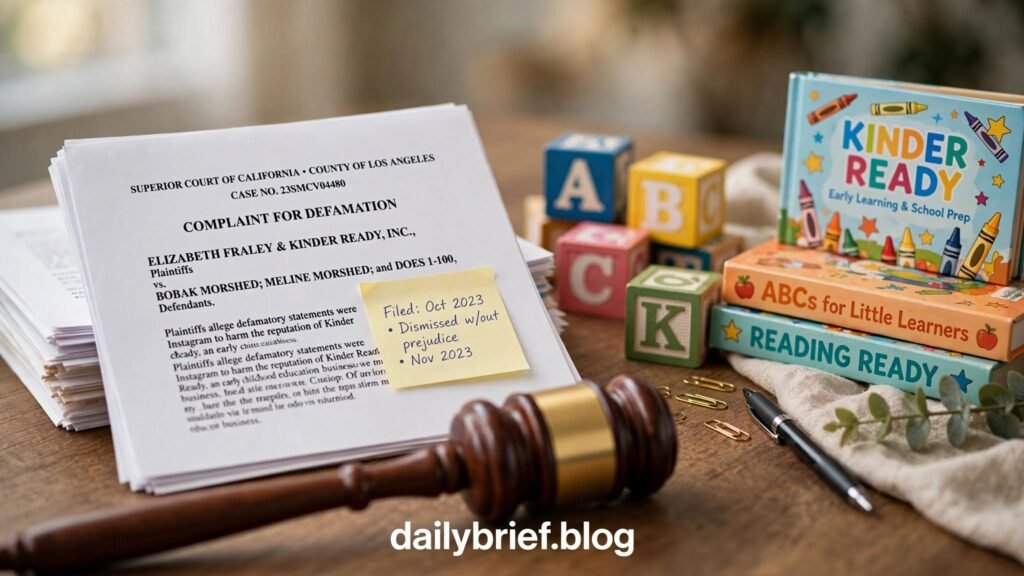
One of the most important details in the Elizabeth Fraley Kinder Ready court case is the reported dismissal without prejudice.
According to the California Courts’ self-help guidance, this type of dismissal generally allows a plaintiff to bring the same claim again, provided applicable legal requirements and deadlines are satisfied. It differs from dismissal with prejudice, which generally prevents the plaintiff from filing the same claim again against the defendant.
In practical terms, a dismissal without prejudice means the case has ended without necessarily resolving the underlying dispute on its merits.
It does not automatically establish that the plaintiffs were right or wrong. Nor does it mean that the defendants were found liable or that a court determined the allegations were false.
Three distinctions are especially important:
- Dismissal is not necessarily a judgment on the facts. The legal action may end without a trial or substantive ruling.
- The reason for dismissal matters. A voluntary withdrawal can occur for different reasons, and the procedural label alone does not explain the parties’ motivations.
- The right to refile is subject to limitations. A dismissal without prejudice does not guarantee that a new lawsuit can be filed successfully or that the applicable deadline remains open.
For the Elizabeth Fraley Kinder Ready court case, the secondary sources reviewed report a dismissal without prejudice but do not establish a definitive reason for that decision.
Consequently, it would be inaccurate to describe the outcome as proof that either side won the underlying dispute.
Was There a Trial or a Final Judgment?
The secondary reporting reviewed for this article does not identify a trial or final judgment resolving the defamation allegations in the reported 2023 case.
That limitation is important when evaluating articles and social media posts about the litigation. Some online summaries use strong language that can make allegations sound like established findings, even when the available information does not demonstrate that a court reached such a conclusion.
Readers should distinguish between four stages of a legal dispute:
- Complaint: A plaintiff presents allegations and requests legal relief.
- Response: A defendant may admit, deny, or otherwise address the claims.
- Court proceedings: The parties may file motions, exchange evidence, negotiate, or pursue other procedural steps.
- Disposition: The action may end through dismissal, settlement-related procedures, or a judicial decision, depending on the circumstances.
These stages are not interchangeable. A complaint does not prove wrongdoing, and the absence of a trial does not prove that the original allegations were false.
Until the relevant court documents establish otherwise, the most responsible description of the Elizabeth Fraley Kinder Ready court case is that it was a reported civil action that ended through a dismissal without prejudice, with no merits judgment identified in the secondary sources reviewed.
How to Verify the Elizabeth Fraley Kinder Ready Court Case
Anyone researching the Elizabeth Fraley Kinder Ready court case should prioritize primary court records over repeated summaries on blogs or other websites.
The official Los Angeles Superior Court provides online tools for locating case information and searching for civil case records. Some document images and name searches may require registration or payment.
You can begin with the court’s official resources:
Search using the reported case number, 23SMCV04480, or the names of the parties.
When reviewing the results, look for the following documents and details:
- The original complaint and the causes of action asserted.
- The names of the plaintiffs and defendants.
- Any filed responses, motions, or judicial orders.
- The request for dismissal and the court’s recorded disposition.
- Any subsequent proceedings that could change the understanding of the case’s status.
The distinction between an online case summary and the underlying court record also matters. The court itself cautions that online case information may be subject to error or omission.
What Should Parents Know About Kinder Ready?
For parents researching Kinder Ready, the court-related search results are only one part of the information worth considering.
A reported lawsuit does not, by itself, establish the quality or effectiveness of educational instruction.
Before choosing a school-readiness or tutoring program, parents can ask practical questions such as:
- What skills will the child develop during the program?
- How are learning needs and progress assessed?
- What qualifications and experience do instructors have?
- How are parents updated about progress and areas requiring additional support?
- What are the fees, cancellation policies, and expectations for participation?
- Can the provider explain how its approach supports age-appropriate learning?
Parents should also distinguish between information published by a business about itself and independent evidence of educational outcomes.
For example, a provider’s description of its teaching methods can help explain its approach, but it does not automatically demonstrate that every child will achieve a particular result.
This approach allows families to make informed decisions without treating unproven allegations as established facts.
Common Misunderstandings About the Elizabeth Fraley Kinder Ready Court Case
Several recurring mistakes can distort the public understanding of this legal matter.
Mistake 1: Assuming the complaint proves misconduct.
A complaint presents one party’s allegations. Whether those allegations are legally sufficient and factually supported depends on the evidence and applicable law.
Mistake 2: Treating dismissal as proof that the allegations were false.
A dismissal without prejudice generally does not resolve the underlying claims on their merits. Its meaning depends on the specific procedural circumstances.
Mistake 3: Assuming the reason for dismissal is known.
Unless the parties or reliable court documents establish the reason, claims about a settlement, private agreement, or litigation strategy remain speculation.
Mistake 4: Treating multiple online articles as independent confirmation.
Several websites may repeat the same original account. Repetition does not necessarily provide additional verification.
Mistake 5: Confusing a civil lawsuit with a criminal case.
Avoiding these mistakes is essential for anyone writing about the Elizabeth Fraley Kinder Ready court case, especially when discussing named individuals and potentially damaging allegations.
Frequently Asked Questions
What is the Elizabeth Fraley Kinder Ready court case?
It refers to a reported 2023 civil defamation lawsuit involving Elizabeth Fraley, Kinder Ready, Inc., John James Chalpoutis, Bobak Morshed, and Meline Morshed. Secondary legal reporting describes allegations concerning social media communications.
What was the reported case number?
Secondary sources identify the case as Los Angeles County Superior Court case 23SMCV04480.
Was the Kinder Ready lawsuit dismissed?
Secondary legal summaries report that the plaintiffs requested a voluntary dismissal without prejudice on November 27, 2023. The official docket is the appropriate source for verifying the recorded disposition.
Were the allegations proven?
The secondary sources reviewed do not identify a trial or final merits judgment resolving the reported defamation allegations. Therefore, the allegations should not be described as judicially proven.
The available reporting reviewed for this article does not establish a definitive reason. Without reliable documentation or statements from the parties, it would be inappropriate to attribute the dismissal to a particular agreement, strategy, or finding.
Where can readers find official court records?
Readers can start with the Los Angeles Superior Court’s official case-search page. Searching by the reported case number or party names may help locate available case information.
Conclusion
The Elizabeth Fraley Kinder Ready court case illustrates why legal reporting should distinguish documented procedural events from disputed allegations. Secondary sources describe a civil defamation action filed in Los Angeles County in October 2023 and reportedly dismissed without prejudice in November of that year.
The available reporting does not establish a final judgment resolving the underlying allegations or a definitive explanation for the dismissal.
For readers seeking a reliable account, the next step is to consult the official court docket, verify the filing and dismissal documents, and avoid relying on unsupported interpretations of the outcome.
Ultimately, a careful understanding of the Elizabeth Fraley Kinder Ready court case depends not on the number of articles discussing it, but on the quality of the evidence supporting each claim.