
What Does ABS Testauslösung Mean?
ABS Testauslösung is a German term that can be understood in English as ABS test activation, ABS test triggering, or controlled ABS testing. In automotive contexts, it generally refers to activating or checking the anti-lock braking system to determine whether its electronic and hydraulic components are working correctly.
The term can appear in workshop diagnostics, repair procedures, brake-system testing, or discussions about an ABS self-check. Understanding it is useful because ABS is a critical safety system that can help maintain steering control when a vehicle brakes heavily.
Depending on the vehicle and diagnostic equipment, ABS Testauslösung may involve an automatic self-test, a professional actuator test, or a controlled functional check. The exact procedure varies between manufacturers, so there is no single testing method that applies to every vehicle.
Quick Facts About ABS Testauslösung
| Question | Quick Answer |
|---|---|
| What does it mean? | ABS test activation or controlled ABS testing |
| What does ABS stand for? | Anti-lock Braking System |
| Main purpose | To verify ABS components and operation |
| Common components checked | Wheel-speed sensors, control unit, valves and hydraulic pump |
| Where is it performed? | Automatically by the vehicle or professionally in a workshop |
| Is professional testing sometimes required? | Yes, especially after ABS-related repairs |
| Should you test ABS aggressively on public roads? | No |
How Does the ABS System Work?
The Anti-lock Braking System is designed to prevent the wheels from remaining locked during heavy braking. Wheel lock can cause the tyres to slide, reducing the driver’s ability to steer around an obstacle.
ABS continuously monitors wheel-speed information and can adjust hydraulic brake pressure when a wheel approaches a lock-up condition. This happens extremely quickly, allowing the driver to continue steering while braking hard.
A typical ABS system includes several important components:
- Wheel-speed sensors
- ABS electronic control unit
- Hydraulic modulator
- Solenoid valves
- Hydraulic pump
- Wiring and electrical connectors
- ABS warning indicator
Modern vehicles may also integrate ABS with systems such as electronic stability control and traction control. Consequently, an ABS-related fault can sometimes trigger additional warning messages.
What Happens During ABS Testauslösung?
The exact process depends on the vehicle manufacturer and the diagnostic system being used. A professional ABS test may communicate directly with the ABS control unit and activate selected components for diagnostic purposes.
The system may check whether:
- Wheel-speed sensors provide plausible signals.
- The ABS control unit communicates correctly.
- Hydraulic components respond to commands.
- Valves can be activated as expected.
- The pump operates correctly.
- Electrical circuits remain within expected parameters.
A diagnostic tool can also help technicians retrieve stored fault codes and examine live sensor information.
This distinction is important: ABS Testauslösung does not necessarily mean that the vehicle is experiencing an emergency ABS event. It can simply refer to a deliberate diagnostic activation or functional test.
ABS Testauslösung vs. Normal ABS Intervention
These two situations are easy to confuse, but they are not the same.
| Feature | ABS Testauslösung | Normal ABS Intervention |
|---|---|---|
| Purpose | Testing or diagnosis | Preventing wheel lock during braking |
| Trigger | Diagnostic procedure or system check | Heavy braking with potential wheel lock |
| Control | Often deliberately initiated | Automatically initiated |
| Main focus | System functionality | Vehicle control and braking |
| Typical environment | Workshop or approved test procedure | Real driving situation |
During genuine ABS intervention, the driver may feel rapid pulsing through the brake pedal. A characteristic buzzing or mechanical sound may also be noticeable.
The sensation should not automatically be interpreted as a malfunction. However, unusual behavior accompanied by warning lights or changes in braking performance deserves professional attention.
When Is ABS Testauslösung Necessary?
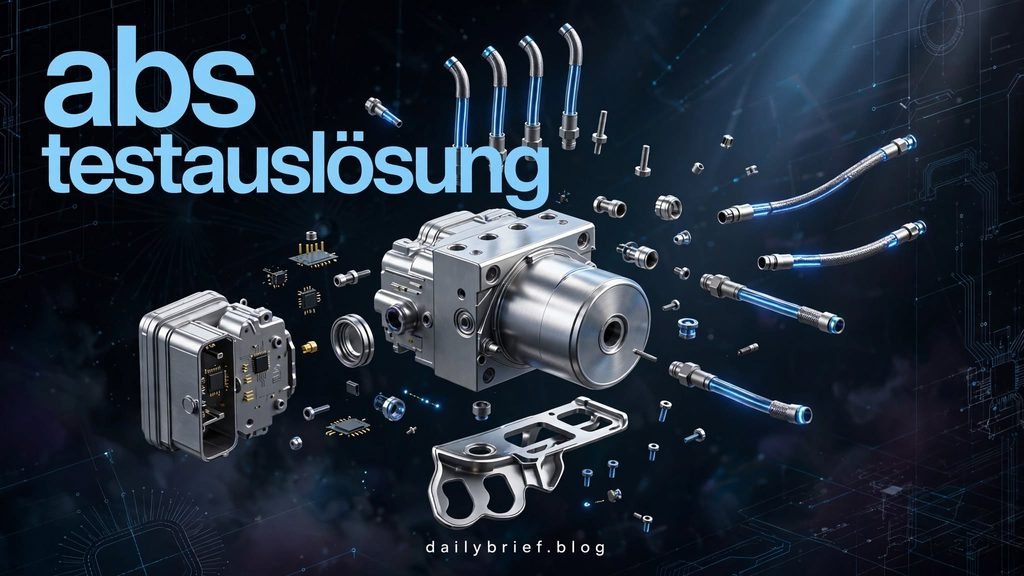
A professional ABS test can be particularly useful after work has been carried out on the braking or ABS system.
Common situations include:
After ABS Control Unit Replacement
Replacing an ABS control module can require additional diagnostic procedures. Depending on the vehicle, coding, calibration, communication checks, or functional tests may be necessary.
A workshop can use suitable diagnostic equipment to verify that the replacement component communicates correctly with the vehicle.
After Hydraulic Unit Repairs
The hydraulic unit is a central part of the ABS system. If it has been replaced or repaired, technicians may need to perform specific procedures to ensure the system has been correctly restored.
This can be particularly important when air may have entered hydraulic circuits during repairs.
After ABS Sensor Replacement
Wheel-speed sensors provide essential information to the ABS controller. A damaged, contaminated, incorrectly installed, or faulty sensor can produce an ABS warning.
After replacement, technicians may check live wheel-speed readings and perform an appropriate road or diagnostic test.
When an ABS Warning Light Appears
A persistent ABS warning light should not be ignored. It indicates that the vehicle has detected a condition requiring investigation.
The vehicle may continue to have conventional braking capability, depending on the fault, but the ABS function itself may be unavailable or limited.
Common ABS Testauslösung Problems
An unsuccessful ABS test does not automatically mean that the entire ABS unit must be replaced. Several different issues can produce similar symptoms.
Faulty Wheel-Speed Sensor
Wheel-speed sensors are exposed to dirt, moisture, vibration, road debris, and temperature changes. A damaged sensor or sensor connection can produce incorrect wheel-speed information.
Technicians can often compare live readings from individual wheels to identify inconsistencies.
Damaged Wiring or Connectors
Electrical problems are another common source of ABS faults. Corrosion, damaged insulation, loose connectors, or broken wires can interrupt communication between sensors and the control unit.
A visual inspection combined with electrical testing can help locate these problems.
ABS Hydraulic Pump Fault
The hydraulic pump is responsible for managing brake pressure during ABS operation. If the pump motor or its electrical circuit fails, an appropriate diagnostic test may reveal that the component does not respond correctly.
Valve or Hydraulic Modulator Problems
The hydraulic modulator contains valves that regulate brake pressure. A mechanical or electrical problem can interfere with correct ABS operation.
Because these components are part of the vehicle’s braking system, repairs should be performed according to the manufacturer’s procedure.
ABS Control Unit Fault
The electronic control unit processes sensor information and controls the ABS system. Internal faults, communication problems, software issues, or power-supply problems can sometimes cause ABS-related warnings.
A diagnostic scan is generally a better starting point than replacing expensive components based only on a warning light.
Can ABS Testauslösung Be Performed at Home?

This depends on what is meant by the test.
Basic visual checks, such as examining the ABS warning light and checking for obvious sensor or wiring damage, may be possible for an experienced vehicle owner. However, deliberately activating ABS components or performing hydraulic procedures is a different matter.
Professional ABS testing may require:
- Vehicle-specific diagnostic software
- Compatible scan equipment
- Manufacturer procedures
- Electrical testing equipment
- Correct brake-bleeding procedures
- Knowledge of the vehicle’s hydraulic system
Because ABS is directly connected to braking safety, experimenting with unknown diagnostic commands is not recommended.
You should also avoid deliberately triggering emergency braking tests on public roads. If a functional road test is required, it should be performed in an appropriate controlled environment by someone qualified to carry it out.
ABS Testauslösung After Brake-System Repairs
Brake-system repairs deserve particular attention because air contamination can affect hydraulic performance.
If an ABS hydraulic unit or related component has been opened, the correct bleeding procedure depends on the vehicle. Some vehicles require a scan-tool-assisted procedure to activate valves or other components during bleeding.
This is one reason generic brake-bleeding instructions should not automatically be applied to every vehicle.
After the work is completed, a qualified technician should confirm that:
- The brake pedal feels normal.
- There are no hydraulic leaks.
- The ABS warning light behaves correctly.
- Relevant diagnostic faults have been resolved.
- Wheel-speed signals are plausible.
- The vehicle responds normally during an appropriate test.
ABS Warning Light: When Should You Act?
A brief ABS warning light during ignition startup can be part of the vehicle’s normal system check. The important issue is what happens afterward.
If the warning light remains illuminated while driving, consult the vehicle’s manual and arrange an appropriate inspection.
Take the situation more seriously if the ABS warning appears together with:
- A brake-system warning light
- A soft or unusually hard brake pedal
- Reduced braking performance
- Unusual noises
- Steering or stability problems
- Multiple electronic safety-system warnings
If braking performance is significantly affected, do not continue driving unnecessarily. Arrange professional assistance instead.
Common Mistakes to Avoid
One of the biggest mistakes is assuming that every ABS warning means the ABS control unit needs replacement. Sensors, wiring, connectors, power supplies, and other components can produce similar symptoms.
Another mistake is clearing diagnostic codes without finding the underlying cause. A warning may disappear temporarily after clearing the fault memory but return once the vehicle detects the problem again.
It is also unwise to use an inexpensive generic scanner for advanced ABS procedures simply because it can read basic engine codes. ABS functions and actuator tests often require vehicle-specific capabilities.
Finally, never treat ABS testing as a substitute for routine brake maintenance. Brake pads, discs, fluid, tyres, and other braking components still require appropriate inspection and servicing.
ABS Testauslösung: A Practical Diagnostic Approach
A sensible approach begins with identifying the exact symptom.
Step 1: Check the warning lights.
Determine whether the ABS light is illuminated alone or together with other warning indicators.
Step 2: Read the diagnostic memory.
Use suitable diagnostic equipment to identify stored ABS-related fault codes.
Step 3: Inspect physical components.
Check relevant sensors, wiring, connectors, wheel areas, and visible hydraulic components.
Step 4: Examine live data.
Where supported, compare wheel-speed signals and other available ABS parameters.
Step 5: Perform the correct functional test.
Use manufacturer-approved procedures rather than guessing which actuator or function should be activated.
Step 6: Verify the repair.
After fixing the identified problem, confirm that the warning has cleared and that the system operates correctly.
This process is generally more reliable than replacing parts based on symptoms alone.
Frequently Asked Questions About ABS Testauslösung
What is ABS Testauslösung in simple terms?
ABS Testauslösung means activating or testing the anti-lock braking system to check whether its components and functions are operating correctly.
Is ABS Testauslösung the same as ABS braking?
No. A diagnostic test is performed to verify system operation, while normal ABS intervention occurs automatically when the system detects conditions where wheel lock may occur.
Why does my ABS warning light stay on?
A continuously illuminated ABS warning light can indicate a stored fault involving a sensor, wiring, control unit, hydraulic component, or another part of the system. Professional diagnosis can identify the actual cause.
Can an ABS fault affect other safety systems?
Yes. Because ABS can communicate with electronic stability and traction-control systems, an ABS fault may be accompanied by additional warning messages depending on the vehicle.
Do I need a professional for ABS Testauslösung?
For advanced diagnostic activation, hydraulic procedures, or post-repair verification, professional equipment and vehicle-specific knowledge are strongly recommended.
Is ABS still important if I rarely drive in rain or snow?
Yes. ABS is not limited to wet or snowy roads. Emergency braking can occur under many conditions, and maintaining steering control during hard braking remains important.
Final Thoughts on ABS Testauslösung
ABS Testauslösung refers to the testing or controlled activation of an anti-lock braking system, particularly during diagnosis, maintenance, or approved functional checks. Understanding the term can make ABS warnings and workshop reports much easier to interpret.
The most important point is that ABS should never be treated as an isolated electronic feature. It is part of the vehicle’s broader braking and stability system, so faults deserve proper diagnosis rather than guesswork.
If an ABS warning light remains illuminated, braking behavior changes, or an ABS-related component has recently been repaired, a qualified technician should follow the vehicle manufacturer’s diagnostic procedure. Correct ABS Testauslösung and verification can help confirm that the system is ready to perform when it matters most.