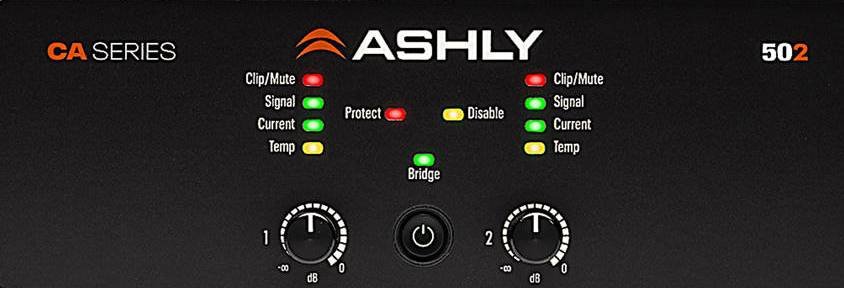
The Ashly CA 502 power amplifier is a professional two-channel amplifier designed for commercial sound systems, installed audio, performance spaces, educational facilities, houses of worship, and other applications where dependable amplification is essential. It combines substantial output with a compact rackmount design, making it a practical option for systems that need flexibility without an oversized amplifier chassis.
What makes this model particularly interesting is its range of operating possibilities. Depending on the system configuration, the amplifier can be used with low-impedance loudspeakers or configured for higher-voltage distributed audio applications.
Quick Facts About the Ashly CA 502 Power Amplifier
| Feature | Details |
|---|---|
| Amplifier configuration | Two channels |
| Amplifier technology | Class D |
| Maximum channel output | Up to 500 watts per channel |
| Low-impedance operation | 2, 4, and 8 ohms |
| Bridged operation | Available |
| Constant-voltage applications | 70V and 100V |
| Rack installation | 19-inch rackmount |
| Input connections | Professional balanced connections |
| Primary market | Commercial and professional audio |
| Typical applications | Installed sound, PA, distributed audio |
| The specifications tell only part of the story. The real advantage of the Ashly CA 502 power amplifier is the way its power, connectivity, and installation features work together in a professional audio system. |
Why Choose the Ashly CA 502 Power Amplifier?
Choosing a professional amplifier is not simply about finding the largest wattage number. A good amplifier needs to match the loudspeakers, impedance, installation environment, operating hours, and expected performance.
The Ashly CA 502 power amplifier is aimed at situations where versatility matters. It can serve a conventional stereo loudspeaker system while also offering configurations that make it useful for larger installation projects.
Its Class D architecture is another important consideration. Compared with older amplifier designs, modern Class D amplifiers can provide substantial output while keeping the chassis relatively compact and reducing unnecessary energy loss.
Power Output Explained
Power ratings can be confusing because an amplifier may have different output figures depending on speaker impedance and operating mode.
The CA 502 is designed to deliver up to 500 watts per channel under specified low-impedance operating conditions. With an 8-ohm load, its output is lower, making it suitable for loudspeakers that require less amplifier power.
This flexibility allows system designers to select the speaker configuration that best fits the application instead of being restricted to one impedance.
2-Ohm Speaker Systems
The ability to work with 2-ohm loads can be useful when multiple compatible loudspeakers are connected to an amplifier channel. However, low-impedance installations should always be designed carefully because the amplifier may have to deliver considerably more current.
Before wiring several speakers together, calculate the final impedance and confirm that the resulting load is supported by the amplifier.
4-Ohm Applications
Four-ohm operation is common in professional sound reinforcement and installed audio. It can provide a useful balance between amplifier output and loudspeaker compatibility.
For many passive PA cabinets and professional installation speakers, 4-ohm operation can be an effective way to utilize the CA 502’s available power.
8-Ohm Applications
Eight-ohm loudspeakers are also common, particularly in conventional distributed or installed sound systems. In this configuration, the amplifier provides a lower power output than it does into a lower impedance.
The important point is that lower wattage does not automatically mean worse performance. The correct amplifier is the one that provides suitable power and headroom for the specific loudspeaker.
Bridged Mode on the Ashly CA 502 Power Amplifier
The Ashly CA 502 power amplifier can also be used in bridged configurations when additional power is required for a suitable load.
In bridge mode, the amplifier’s two channels work together to drive a single output. This can be useful when one loudspeaker or speaker system needs more power than an individual channel can provide.
However, bridge mode should not be treated as a simple switch that makes every speaker configuration possible. The speaker impedance and wiring must comply with the manufacturer’s specifications.
A common mistake is connecting an unsuitable low-impedance speaker to a bridged amplifier. Always check the manual and amplifier labeling before making the connection.
70V and 100V Distributed Audio
One of the reasons the Ashly CA 502 power amplifier can appeal to commercial installers is its suitability for constant-voltage audio systems.
70V and 100V systems are widely used in environments where numerous speakers need to be distributed throughout a building. Instead of running a conventional low-impedance connection to every speaker, the system uses transformer-equipped loudspeakers connected to a higher-voltage distribution line.
This approach is useful for:
- Schools
- Retail stores
- Restaurants
- Corporate offices
- Houses of worship
- Conference facilities
- Public buildings
- Background music systems
- Paging systems
The total speaker tap load must be calculated correctly before selecting the amplifier. A system with dozens of speakers can place a substantial demand on an amplifier if the individual transformer taps are set too high.
Professional Connectivity
The Ashly CA 502 power amplifier is built with professional installation in mind rather than consumer-style home audio connections.
Balanced inputs are particularly useful in professional environments because they can help reduce the impact of unwanted electrical noise over longer cable runs.
The amplifier’s connection options also make it easier to integrate with mixers, signal processors, digital signal processors, and other professional audio equipment.
For permanent installations, organized cable management is important. Labeling every input and output can make future troubleshooting considerably easier.
Gain Structure and System Setup
A powerful amplifier cannot compensate for poor gain structure. If the mixer or processor sends an excessively hot signal into the amplifier, distortion can occur even when the loudspeaker itself is capable of handling the available power.
A sensible setup starts with the source equipment and moves through the signal chain toward the amplifier. Each device should operate within an appropriate range rather than forcing the final amplifier to compensate for poor levels elsewhere.
When setting up the Ashly CA 502 power amplifier, pay attention to:
- Source output level.
- Mixer or DSP gain.
- Amplifier input sensitivity.
- Speaker impedance.
- Limiter settings.
- Maximum desired sound-pressure level.
- Available headroom.
Proper gain structure can produce a cleaner and more predictable system than simply increasing amplifier volume.
Cooling and Installation Considerations
Professional amplifiers may operate for many hours continuously, so ventilation is an important part of installation.
The Ashly CA 502 power amplifier uses an active cooling design intended to manage operating temperature. Nevertheless, installers should never assume that the amplifier can be placed in a completely sealed rack or cabinet.
When installing the amplifier:
- Maintain appropriate airflow around the rack equipment.
- Avoid blocking ventilation openings.
- Keep excessive heat-producing equipment from restricting airflow.
- Ensure the rack is suitable for the amplifier’s weight.
- Keep signal and power wiring organized.
A properly ventilated amplifier is more likely to deliver consistent performance during extended operation.
Ashly CA 502 Power Amplifier for Commercial Installations
Commercial installations often have different requirements from mobile DJ or home audio systems. Equipment may need to run for many hours, remain accessible to technicians, and integrate with other rack-mounted devices.
The CA 502 fits this environment well because it provides two amplifier channels in a professional rackmount format.
For example, a school could use separate channels for different speaker zones, while a small venue might dedicate one channel to a main loudspeaker and another to a secondary system. The exact configuration depends on the speaker system and system processor.
Ashly CA 502 Power Amplifier for Live Sound
Although the model is strongly suited to fixed installations, its professional amplification capabilities can also make it useful in appropriate live-sound applications.
For a small performance system, the amplifier can provide power for passive loudspeakers without requiring an excessively large rack setup.
However, users who regularly transport equipment should consider weight, connector preferences, built-in DSP requirements, and other features before choosing an amplifier.
If the system needs integrated crossover functions, equalization, speaker presets, networking, or extensive remote monitoring, a modern DSP-equipped amplifier may provide a better solution.
Ashly CA 502 vs. an Amplifier With Built-In DSP
One of the most important buying decisions is whether you need an amplifier with integrated digital processing.
The Ashly CA 502 power amplifier can be an excellent choice when the system already has an external DSP or processor. In this arrangement, the amplifier focuses on amplification while another device manages equalization, crossover points, delays, limiting, and routing.
A DSP amplifier, by comparison, combines several functions in one unit. That can simplify some installations but may also increase cost and complexity.
Choose the CA 502 when:
- You already have a DSP.
- You need straightforward amplification.
- You value flexible speaker configurations.
- You are building a conventional rack system.
Consider an integrated DSP amplifier when: - You want speaker presets.
- You need extensive system routing.
- Network monitoring is important.
- You want fewer rack components.
Pros and Cons of the Ashly CA 502
Pros
- Professional two-channel configuration
- Strong output for its class
- Flexible impedance support
- Bridged operation
- Suitable for commercial distributed audio
- Compact rackmount format
- Class D efficiency
- Professional balanced connectivity
- Useful for permanent installations
Cons
- May be more advanced than necessary for basic home audio
- Requires careful impedance planning
- Bridge mode requires appropriate speaker selection
- External DSP may be needed for advanced system processing
- Professional connectors may be less familiar to casual users
The advantages become more significant when the amplifier is being installed as part of a properly designed professional system.
What Speakers Work Best With the Ashly CA 502?
There is no single “best” speaker for the Ashly CA 502 power amplifier. The correct match depends on impedance, continuous and peak power handling, sensitivity, application, and the desired sound level.
For a low-impedance system, confirm the loudspeaker’s nominal impedance and recommended amplifier range. For a 70V or 100V system, calculate the combined transformer tap wattage instead.
Speaker sensitivity deserves particular attention. A highly sensitive loudspeaker can produce greater acoustic output from the same amplifier power than a less sensitive design.
This is why matching an amplifier solely by wattage can result in an inefficient system.
Common Mistakes When Buying an Amplifier
Mistake 1: Focusing Only on Wattage
A 1,000-watt amplifier is not automatically better than a 500-watt amplifier. If the speakers and room do not require the additional output, extra power may simply increase cost without improving the installation.
Mistake 2: Ignoring Impedance
Connecting a speaker load below the amplifier’s supported impedance can cause protection events or other operational problems.
Always calculate the final load before installation.
Mistake 3: Forgetting Headroom
Running an amplifier continuously at its limit is rarely ideal. A properly designed system should have enough headroom for normal peaks without constantly reaching clipping.
Mistake 4: Ignoring Ventilation
Even efficient amplifiers generate heat. A crowded rack with inadequate airflow can create unnecessary thermal stress.
Mistake 5: Choosing Features You Do Not Need
Network control, DSP, remote monitoring, and advanced routing are valuable features—but only when the project actually requires them. A straightforward amplifier can be the better choice when the rest of the system already provides those functions.
Buying Checklist for the Ashly CA 502 Power Amplifier
Before purchasing, evaluate the complete audio system rather than the amplifier in isolation.
Check these points:
- Speaker impedance: Confirm that the amplifier supports your intended load.
- Power requirement: Compare amplifier output with the loudspeaker’s recommended power range.
- Application: Decide whether the system is low-impedance or constant-voltage.
- Number of channels: Confirm that two channels are sufficient.
- DSP: Determine whether external processing is already available.
- Rack space: Measure the available installation space.
- Electrical supply: Verify compatibility with the installation’s power requirements.
- Future expansion: Consider whether additional speakers or zones may be added later.
This checklist can prevent many expensive installation mistakes.
Is the Ashly CA 502 Power Amplifier Worth It?
For the right installation, the Ashly CA 502 power amplifier can be a strong choice because it prioritizes practical professional features rather than unnecessary complexity.
Its ability to work across multiple speaker configurations gives system designers more freedom. The rackmount construction and efficient amplifier architecture are also well suited to commercial environments where equipment may remain powered for long periods.
It becomes less compelling if you specifically need integrated DSP, extensive networking, or an all-in-one digital amplifier platform. In those situations, another model may offer a more complete feature set.
Final Verdict
The Ashly CA 502 power amplifier is a flexible professional amplification solution for installations that require reliable two-channel power, multiple speaker-load options, and a rack-friendly design. Its combination of output capability, low-impedance support, bridged operation, and suitability for distributed audio makes it useful across a broad range of commercial sound applications.
The best way to evaluate it is to start with the speakers and installation requirements, then determine whether the CA 502 provides the required power and connectivity. When those requirements align, this amplifier can be a practical foundation for a clean, scalable, and professionally configured sound system.