Introduction
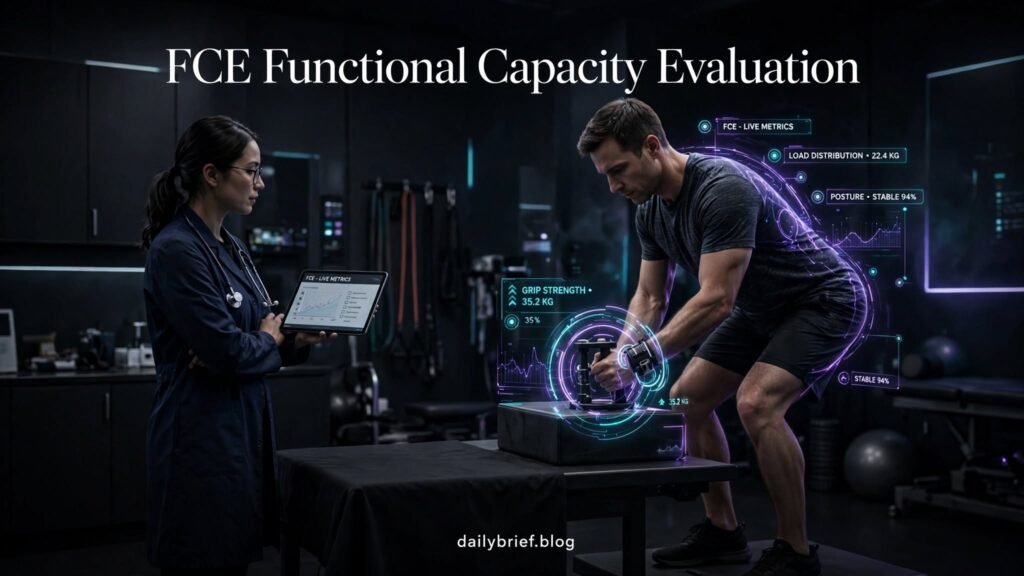
An FCE functional capacity evaluation is a structured assessment used to understand how well a person can perform physical activities related to work or daily functioning. FCE stands for Functional Capacity Evaluation. It commonly involves a review of medical history, a physical assessment, and practical tasks such as lifting, carrying, pushing, pulling, bending, walking, and standing. The specific tests depend on the individual’s condition and the purpose of the evaluation.
A healthcare professional may recommend an FCE when someone is recovering from a workplace injury, experiencing physical limitations, or preparing to return to work after an extended absence. The results can help clarify current abilities, identify restrictions, and guide rehabilitation or workplace accommodations. They may also be used by employers, insurers, or rehabilitation professionals when evaluating work-related questions.
However, an FCE is not a medical diagnosis, and it does not automatically determine whether someone is permanently disabled or ready to resume every job duty. Its findings must be interpreted alongside medical information, job requirements, and the person’s overall recovery.
Understanding the assessment beforehand can make the process less stressful. This guide explains what an FCE measures, who may need one, how the evaluation works, how to prepare, what the results mean, and which questions to ask your healthcare provider.
What Is an FCE Functional Capacity Evaluation?
A functional capacity evaluation is a performance-based assessment that measures a person’s ability to complete selected physical tasks safely and within their current functional limits.
The evaluation is often conducted by a qualified physical therapist or occupational therapist with appropriate training in functional testing. Depending on the setting, other suitably qualified rehabilitation professionals may also be involved.
Unlike a routine medical appointment that focuses primarily on symptoms, diagnosis, or treatment, an FCE examines how a person performs practical activities. The assessor may compare observed abilities with the physical demands of a particular job.
For example, a warehouse employee recovering from a back injury may need to lift packages, move materials, stand for extended periods, and walk around a worksite. An FCE can help assess relevant abilities and identify tasks that may require restrictions or modifications.
The findings typically describe the activities assessed, the person’s performance, relevant limitations, and recommendations for further rehabilitation or work planning.
What Does FCE Stand For?
FCE stands for Functional Capacity Evaluation. You may also encounter related terms such as work capacity evaluation, functional abilities evaluation, or functional capacity assessment.
These terms can overlap, but they are not always interchangeable. Different providers use different testing systems, and some assessments also examine cognitive or other work-related abilities.
The important question is what the specific evaluation measures, how it will be conducted, and how its results will be used.
Why Is a Functional Capacity Evaluation Performed?
An FCE may be requested when a healthcare professional, employer, insurer, or rehabilitation team needs more detailed information about a person’s functional abilities.
Common reasons include:
1. Returning to work after an injury
After an injury or surgery, a person may feel better but remain uncertain about lifting, standing, bending, or other demanding tasks. An FCE can help establish which activities the person can currently perform and whether modifications may be appropriate.
2. Identifying physical restrictions
The evaluation may help clarify limitations involving strength, endurance, mobility, or tolerance for particular postures. These findings can support discussions about temporary work restrictions or adjusted duties.
3. Planning rehabilitation
An FCE can identify areas where additional treatment, conditioning, or work-specific rehabilitation may be helpful. It can also provide information for monitoring functional progress when a comparable reassessment is appropriate.
4. Matching abilities to job demands
A job-specific assessment may compare a person’s performance with essential physical requirements, such as lifting materials, climbing stairs, operating equipment, or maintaining a standing position.
5. Supporting disability-related or insurance decisions
In some cases, an FCE report contributes to workers’ compensation, disability, vocational rehabilitation, or other administrative decisions. However, the assessment is only one source of information. Its legal or insurance significance depends on the applicable rules and the circumstances of the case.
Who May Need an FCE?

An FCE may be considered for people whose health conditions affect their ability to perform physical activities or work duties.
Examples include:
- Employees recovering from back, shoulder, knee, or other musculoskeletal injuries.
- People returning to physically demanding jobs after surgery.
- Workers who have difficulty sustaining their normal duties.
- Individuals participating in occupational rehabilitation.
- People whose treating clinicians need additional information about functional restrictions.
- Individuals undergoing vocational planning after an injury or illness.
Not everyone recovering from an injury needs an FCE. The decision should depend on the person’s medical condition, rehabilitation goals, job demands, and whether the assessment is likely to provide useful information.
A treating clinician should clarify whether the proposed activities are appropriate for the individual’s current health status.
What Does an FCE Measure?
The exact tests vary by assessment protocol, medical restrictions, and the physical demands being evaluated.
| Assessment area | What it may evaluate | Example task |
|---|---|---|
| Lifting and carrying | Ability to handle loads at specified levels or over distances | Lifting a box from a waist-height surface |
| Pushing and pulling | Force and control during movement of an object | Moving a weighted cart |
| Grip strength | Hand-gripping ability | Holding a testing handle |
| Range of motion | Movement of joints and body regions | Reaching overhead |
| Postural tolerance | Ability to maintain or change positions | Sitting, standing, kneeling, or squatting |
| Walking and mobility | Movement, balance, and functional tolerance | Walking a defined distance |
| Endurance | Ability to sustain selected activities | Repeated lifting or walking |
| Job-specific function | Ability to perform relevant work tasks | Simulated material handling |
Not every FCE includes every test. A desk-based employee, for example, may need a different assessment approach from a construction worker who regularly carries heavy materials.
An FCE also does not necessarily measure every aspect of a person’s health. Psychological, cognitive, sensory, and medical factors may require separate assessment or additional tools, depending on the question being investigated.
What Happens During an FCE Functional Capacity Evaluation?
Although the process differs between providers, most evaluations follow several general stages.
Step 1: Medical history and initial interview
The assessor reviews relevant information about the person’s injury or condition, treatment history, current symptoms, medications, and functional concerns.
You may be asked about:
- When the injury or symptoms began.
- Which activities cause discomfort or difficulty.
- What treatment you have received.
- Whether you use braces, a cane, or other assistive devices.
- Which work tasks you previously performed.
- What activities you can currently complete at home and at work.
Answer questions honestly and describe your current abilities rather than what you could do before the injury.
Step 2: Initial physical assessment
The evaluator may assess movement, strength, flexibility, balance, and other relevant physical functions. This stage helps identify potential safety concerns and determine which activities are appropriate.
If your medical records identify specific restrictions, the assessor should consider them when planning the tests.
Step 3: Functional testing
You may perform selected activities that resemble everyday or work-related movements. These could include lifting objects, carrying loads, pushing or pulling equipment, reaching, walking, climbing steps, or maintaining certain positions.
The evaluator observes performance and may record factors such as the amount of weight handled, duration of activity, movement quality, and reported symptoms.
The goal is to understand your functional capacity under the conditions of the assessment, not to encourage you to push through unsafe pain.
Step 4: Monitoring symptoms and tolerance
During testing, the evaluator may monitor fatigue, discomfort, movement patterns, and other relevant signs. Rest periods may be provided according to the protocol and your needs.
If an activity causes significant pain, dizziness, unusual shortness of breath, or another concerning symptom, tell the evaluator immediately. Testing may need to be modified, paused, or stopped.
Step 5: Analysis and written report
After the tests, the evaluator reviews the findings and prepares a report. Depending on the assessment, it may describe functional abilities, observed limitations, performance consistency, and recommendations for rehabilitation or work modifications.
The report may be shared with the referring clinician or other authorized parties, depending on the referral arrangements, consent, and applicable privacy rules.
How Long Does an FCE Take?
The duration depends on the assessment protocol, the person’s condition, the number of tasks required, and whether the evaluation needs to simulate sustained work activities.
Some FCEs take approximately four hours, while others require a longer session or testing over two days. Johns Hopkins Medicine describes evaluations that commonly take around four hours, with some protocols extending across two consecutive days. See its functional capacity evaluation guidance.
Before your appointment, ask the provider:
- How long should I plan to be there?
- Will the evaluation take place over one day or multiple days?
- Are breaks included?
- Should I arrange transportation afterward?
- Is there anything I should avoid doing before the assessment?
Plan for the expected duration rather than assuming that every FCE follows the same schedule.
How to Prepare for an FCE
Preparation helps the assessor understand your current condition and conduct the evaluation as safely and accurately as possible.
Before the appointment
Gather relevant medical information. Bring any requested referral documents, details of your injury, and relevant treatment information. The clinic may already have some of these records.
Prepare a medication list. Include your current medications and follow your prescribing clinician’s instructions. Do not stop or change medication simply to influence the evaluation.
Understand your work duties. If the FCE is job-specific, ask whether the assessor has a description of your role and its physical demands.
Wear comfortable clothing. Choose clothes that allow movement and footwear suitable for the activities described by the clinic.
Bring assistive devices. Take any brace, orthotic, cane, or other aid you normally use if the provider requests it.
Follow the clinic’s instructions. Ask about eating, hydration, physical activity, and any preparation requirements specific to your assessment.
During the evaluation
- Describe pain, fatigue, and other symptoms accurately.
- Ask for clarification if you do not understand a task.
- Request a break when necessary.
- Tell the evaluator if an activity feels unsafe.
- Do not exaggerate your limitations or attempt to demonstrate abilities beyond your current capacity.
There is no reliable shortcut to a meaningful FCE result. Honest communication and safe participation are more useful than trying to achieve a particular test score.
Understanding FCE Results
An FCE report provides information about the activities performed and the person’s observed functional capacity. The findings may help a rehabilitation team compare current abilities with the demands of a job.
For example, a report might indicate that a person can perform certain lifting activities but has limited tolerance for prolonged standing. If standing is essential to the job, the findings may support a discussion about modified duties, additional rehabilitation, or changes to the work schedule.
What may appear in the report?
Depending on the assessment, the report may include:
- Medical and occupational background relevant to the referral.
- Tests performed and conditions under which they were completed.
- Measured performance and observed movement.
- Reported symptoms and relevant limitations.
- A comparison between assessed abilities and identified job requirements.
- Recommendations for further evaluation, rehabilitation, or workplace adjustments.
Does an FCE determine whether someone is disabled?
Not by itself. An FCE describes functional performance under the conditions assessed. A disability determination may also require medical evidence, information about daily activities, occupational requirements, applicable legal definitions, and other criteria.
Likewise, a particular test result does not automatically establish that someone can safely perform every duty of a job.
The report should be interpreted by the relevant healthcare professionals and decision-makers within the proper clinical, occupational, and legal context.
FCE vs. a Regular Physical Examination
An FCE and a routine physical examination serve different purposes, although they may complement one another.
| Feature | Functional capacity evaluation | Routine physical examination |
|---|---|---|
| Main purpose | Assess functional abilities relevant to specific activities or work | Evaluate health, symptoms, and clinical findings |
| Typical activities | Structured physical or job-related tasks | History, examination, and condition-specific tests |
| Main focus | Performance, tolerance, and functional limitations | Diagnosis, health assessment, and treatment planning |
| Work relevance | Often directly linked to job demands | May inform work recommendations but is not always job-specific |
| Outcome | Functional findings and recommendations | Clinical assessment and treatment plan |
An FCE does not replace appropriate medical care. A physician may need to diagnose or treat the underlying condition, while a therapist or other qualified evaluator assesses the person’s ability to perform particular activities.
FCE vs. Work Hardening
These terms are related but describe different activities.
A functional capacity evaluation assesses current abilities and limitations. Work hardening is a rehabilitation program designed to help a person build work-related strength, endurance, coordination, and task tolerance.
| Feature | FCE | Work hardening |
|---|---|---|
| Primary purpose | Assess functional capacity | Improve work-related function |
| Typical approach | Structured evaluation and testing | Repeated, progressive therapeutic activities |
| Main outcome | Findings and recommendations | Progress toward functional rehabilitation goals |
| Timing | May occur before or after rehabilitation, as appropriate | Often used when further conditioning is needed |
A clinician may recommend work hardening after reviewing FCE findings, but the appropriate plan depends on the person’s condition and goals.
Benefits and Limitations of an FCE
A well-planned FCE can provide useful information, but its findings should not be interpreted as a complete picture of every aspect of health or future work ability.
Potential benefits
- Provides structured information about selected physical abilities.
- Helps identify activities that may require modification.
- Supports discussions about rehabilitation goals.
- Helps compare assessed capacity with known job demands.
- May inform a graduated return-to-work plan.
- Can document functional changes when repeated assessments are appropriate.
Important limitations
- Performance during testing may not fully reflect every workday or working environment.
- Symptoms, fatigue, medication effects, and the testing conditions may affect performance.
- A limited assessment cannot measure every task a job requires.
- Results do not guarantee future recovery or predict every possible complication.
- The evaluation alone may not determine legal disability status or fitness for all duties.
The findings are most useful when the evaluation has a clear purpose, uses appropriate testing methods, and considers the person’s actual work requirements.
Practical Advice: What to Do After an FCE
Once the assessment is complete, use the report as a starting point for a discussion with your treating clinician and, where appropriate, your rehabilitation or occupational health team.
Review the findings carefully
Ask the evaluator or referring clinician to explain unfamiliar terms and clarify which activities were assessed. Make sure you understand the difference between a measured limitation and a recommendation about work duties.
Discuss work restrictions
If the report identifies restrictions, ask how they apply to your specific job. A restriction on heavy lifting, for instance, may require temporary task reassignment, mechanical assistance, or a modified return-to-work schedule.
Ask about rehabilitation options
If the assessment identifies reduced endurance, strength, or movement tolerance, ask whether additional treatment or work-specific conditioning could help.
Clarify who makes the final decision
An evaluator provides findings and recommendations within their professional role. Return-to-work authorization, insurance determinations, and disability decisions may involve other professionals or authorities, depending on the circumstances.
Seek medical guidance for worsening symptoms
Do not assume that all discomfort during recovery is harmless. Contact your healthcare professional if symptoms worsen or persist after the evaluation. Seek urgent medical attention for serious warning signs such as chest pain, severe difficulty breathing, fainting, or sudden new weakness.
Your health and safety take priority over completing a test or meeting a return-to-work target.
Frequently Asked Questions About FCE Functional Capacity Evaluation
1. What is the main purpose of an FCE functional capacity evaluation?
Its main purpose is to assess selected functional abilities and limitations, often in relation to work tasks. The findings can help guide rehabilitation, work restrictions, accommodations, or return-to-work planning.
2. Is a functional capacity evaluation painful?
It should be conducted within appropriate safety limits, but some tasks may cause fatigue or discomfort. Tell the evaluator immediately if you experience pain or feel unable to perform an activity safely.
3. How long does an FCE test take?
Some assessments take around four hours, while others may require longer sessions or two days of testing. The duration depends on the protocol, the person’s condition, and the work demands being assessed.
4. Who performs a functional capacity evaluation?
FCEs are commonly performed by qualified physical therapists or occupational therapists with relevant training. The professional responsible may vary according to the provider, jurisdiction, and assessment requirements.
5. What should I wear to an FCE?
Wear comfortable clothing that allows movement and suitable closed-toe footwear if recommended. Bring prescribed braces or other assistive devices and follow the testing clinic’s specific instructions.
6. Can I fail a functional capacity evaluation?
An FCE is not generally a pass-or-fail examination in the same way as a school test. It records performance, tolerance, and limitations during selected tasks. The report should be interpreted according to the purpose of the evaluation and the person’s circumstances.
7. Can an FCE determine permanent disability?
An FCE alone does not establish permanent disability. Its findings may contribute to a broader assessment, but medical evidence, applicable definitions, occupational information, and other relevant factors may also be required.
8. What happens if I cannot complete an FCE test?
Tell the evaluator why you cannot continue, whether the reason is pain, fatigue, dizziness, or another concern. The evaluator can document the limitation and determine whether the task should be modified, paused, or stopped.
Conclusion
An FCE functional capacity evaluation provides structured information about a person’s ability to perform selected physical activities, often following an injury or before returning to work. It can help clarify functional limitations, identify possible workplace accommodations, and guide rehabilitation planning.
The most important step is to understand what your particular evaluation is designed to measure. Prepare by following the provider’s instructions, describing your symptoms honestly, and asking questions about any restrictions or recommendations. Remember that an FCE is one part of a broader decision-making process, not a stand-alone diagnosis or guarantee of work fitness.
If you have been referred for an FCE, discuss the purpose of the assessment and how the results will be used with your healthcare provider. This can help you approach the evaluation with realistic expectations and a clearer plan for your next steps.