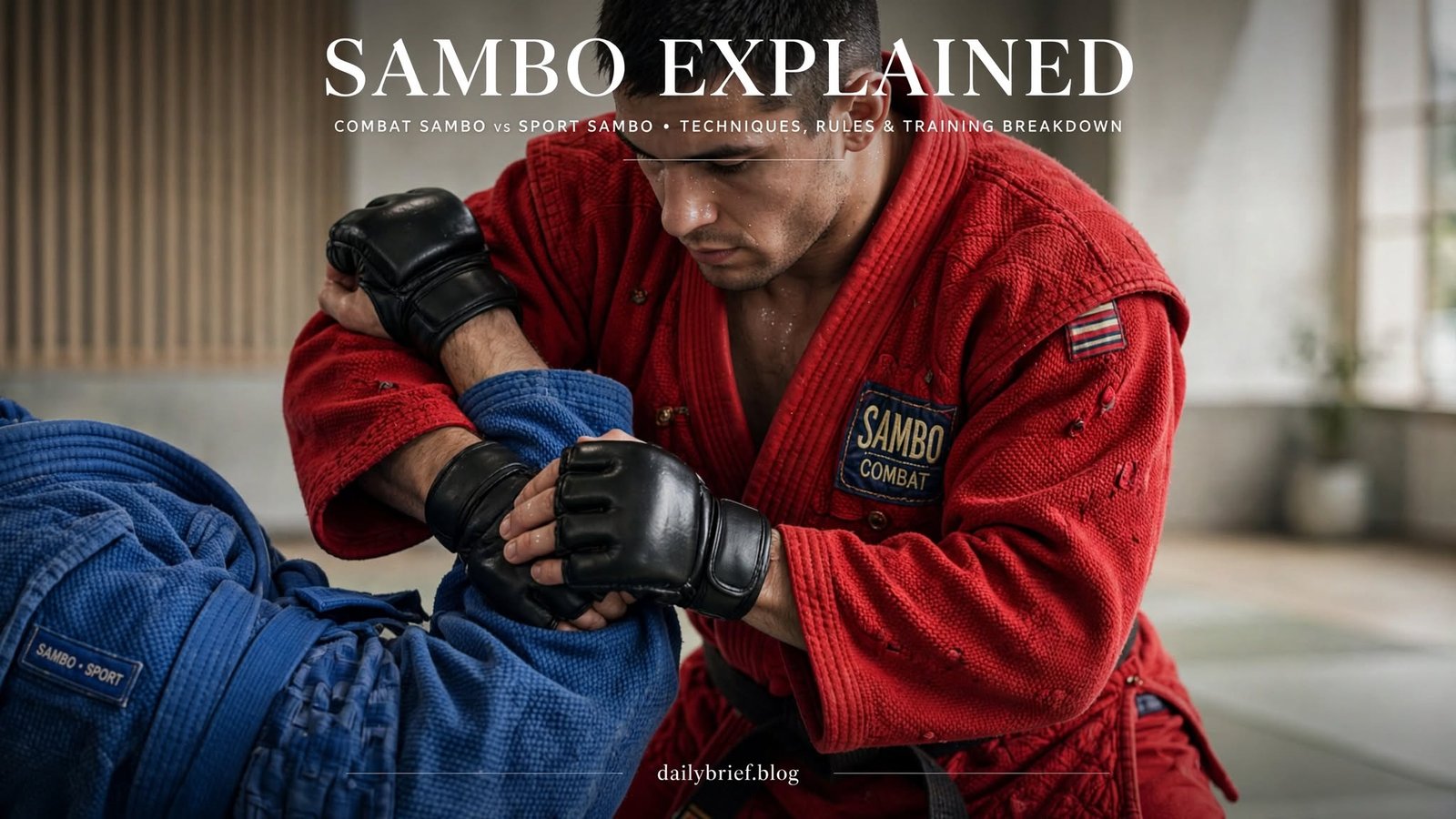
Sambo Explained starts with a simple question: what makes this Russian martial art different from judo, wrestling, and Brazilian jiu-jitsu? Sambo is a dynamic combat sport that combines throws, grappling, takedowns, and submission techniques to develop practical fighting skills. Depending on the discipline, it can also include punches and kicks.
Developed in the Soviet Union during the 20th century, Sambo has grown into an international sport practiced by athletes at different skill levels. It emphasizes balance, movement, timing, and the ability to control an opponent rather than relying entirely on physical strength.
Whether you are a martial arts enthusiast, a beginner looking for a training discipline, or simply curious about Sambo fighting techniques, this guide explains its origins, major styles, rules, benefits, and differences from other combat sports.
What Is Sambo?
Sambo is a martial art and combat sport whose name comes from a Russian expression meaning self-defense without weapons. Its techniques draw on several wrestling traditions and martial arts, particularly judo and other grappling systems.
The central objective is to defeat an opponent through effective throws, takedowns, positional control, or permitted submission techniques. In Combat Sambo, striking techniques are also part of the competition.
Unlike martial arts that primarily focus on punching or kicking, traditional Sambo training places considerable emphasis on controlling an opponent at close range. Practitioners learn how to disrupt balance, move efficiently, defend against attacks, and transition between standing and ground positions.
Sambo is organized internationally through the International Sambo Federation (FIAS), which oversees international competition frameworks and publishes rules for different disciplines.
What Does SAMBO Stand For?
SAMBO is an acronym derived from the Russian phrase SAMozashchita Bez Oruzhiya, commonly translated as self-defense without weapons.
The name reflects the original purpose of the discipline: developing effective unarmed defense skills. Over time, those methods evolved into an organized competitive sport with standardized training methods, weight categories, and competition rules.
Today, it serves several purposes:
- Sport: Competing against opponents using regulated grappling techniques.
- Self-defense training: Developing balance, awareness, defensive movement, and physical control.
- Combat training: Practicing a broader range of techniques, including striking in Combat Sambo.
- Athletic development: Improving strength, coordination, agility, and conditioning.
The History of Sambo
Sambo emerged in the Soviet Union during the early 20th century. Rather than being invented by one individual in a single moment, it developed through the work of several martial arts specialists who studied existing fighting systems and adapted their techniques.
Among the important figures associated with its development were Vasili Oshchepkov, Viktor Spiridonov, and Anatoly Kharlampiev. Their contributions helped shape the techniques, training methods, and organized practice that eventually became modern Sambo.
How Sambo Developed
The development of it involved the study of judo, wrestling, and traditional grappling methods from different regions. The goal was to combine useful techniques into a practical and adaptable system.
An important milestone occurred on November 16, 1938, when Sambo received official recognition in the Soviet Union as a distinct form of wrestling. This date is widely recognized as the sport’s official birth date.
It subsequently expanded beyond its original environment. International championships and the establishment of governing organizations helped introduce the sport to athletes around the world.
As participation increased, the discipline developed more clearly defined competitive formats. Sport Sambo and Combat sambo became especially prominent, each emphasizing different combinations of techniques and rules.
Today, international events bring together athletes from different countries and provide opportunities for competitors to test their skills under regulated conditions.
Types of Sambo Explained
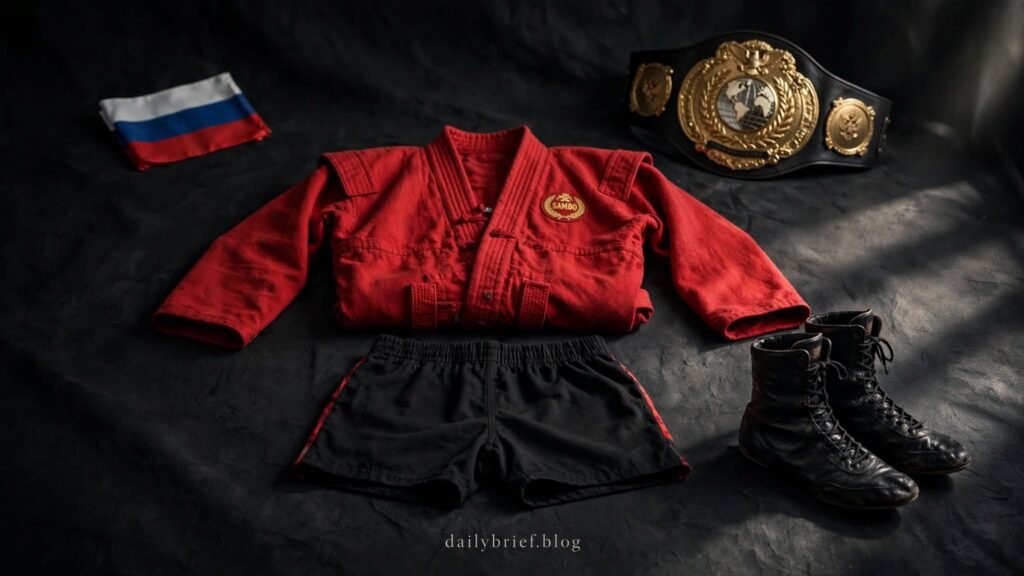
Understanding the different Sambo disciplines is essential because their rules, permitted techniques, and training priorities are not identical.
1. Sport Sambo
Sport Sambo focuses primarily on throws, takedowns, ground control, and permitted submission techniques. Competitors wear a traditional jacket, shorts, and specialized wrestling shoes.
The objective is to outperform the opponent through effective technical actions or achieve a decisive victory under the applicable rules.
Typical Sport Sambo techniques include:
- Trips and sweeping techniques.
- Hip and leg throws.
- Body-control takedowns.
- Pins and positional control.
- Permitted arm and leg joint locks.
Sport Sambo does not permit the same striking techniques found in Combat Sambo. Chokes are generally not part of standard Sport Sambo competition, although athletes should consult the current rules for their particular event.
This discipline suits athletes who enjoy technical grappling, fast transitions, and tactical competition.
2. Combat Sambo
Combat combines grappling with striking, making it a broader combat sport than the standard sporting format.
Depending on the applicable rules, athletes can use punches, kicks, throws, takedowns, ground control, and permitted submission techniques. Competitors typically wear additional protective equipment compared with athletes in Sport.
The combination of striking and grappling means participants must develop skills in several areas. They need to manage distance while standing, defend against strikes, execute takedowns, and recognize opportunities for submissions.
Combat Sambo training can be physically demanding because athletes must respond to changing situations rather than concentrating exclusively on wrestling exchanges.
Beginners should learn the fundamentals in a supervised environment before attempting hard sparring or advanced fighting combinations.
3. Beach Sambo
Beach it is a variation designed for competition on sand. It retains elements of grappling and throwing while adapting the competition format to a different surface and environment.
Sand changes how athletes move, maintain balance, and generate force. Footwork, timing, and body positioning therefore become particularly important.
The surface may soften certain falls, but it does not eliminate the risk of injury. Competitors still require appropriate coaching, conditioning, and knowledge of the rules.
FIAS publishes separate regulatory documents for Beach this alongside other competition formats.
Sambo Styles Compared
| Feature | Sport Sambo | Combat Sambo | Beach Sambo |
|---|---|---|---|
| Main focus | Grappling and throws | Striking and grappling | Grappling on sand |
| Striking | Not permitted | Permitted under the rules | Not the defining feature |
| Throws and takedowns | Yes | Yes | Yes, subject to rules |
| Submission techniques | Permitted techniques | Permitted techniques | Governed by its own rules |
| Competition surface | Mat | Mat | Sand |
| Best suited to | Technical grappling | Broader combat skills | Sand-based grappling competition |
Exact rules can differ by age group, event category, and competition edition. Always check the regulations for the event in which you plan to participate.
Essential Sambo Techniques
It combines offensive and defensive techniques that help athletes gain control over an opponent. The most effective practitioners understand not only how to perform a move but also when to use it.
Throws and Takedowns
Throws are among the most recognizable its techniques. Athletes use grips, body positioning, leverage, and changes in direction to move an opponent off balance and bring them to the mat.
Common categories include hip throws, leg attacks, trips, and sweeping movements.
For beginners, balance and timing are more valuable than trying to generate maximum force. Learning how to fall safely is also essential because throwing and takedown drills involve frequent contact with the ground.
Leg Locks and Joint Locks
It is known for its emphasis on permitted leg locks, which distinguish it from some other grappling disciplines. Depending on the applicable rules, athletes may also use selected arm-locking techniques.
These submissions apply pressure to a joint or limb, forcing an opponent to submit or risk injury.
They require careful technical control. Beginners should practice them slowly under qualified supervision, release immediately when a training partner signals submission, and avoid forcing a joint beyond its safe range of motion.
Ground Control
Ground control allows a practitioner to stabilize an opponent, improve position, and prepare for a legal submission or scoring opportunity.
Effective control often comes from positioning rather than brute strength. Athletes use pressure, weight distribution, grip management, and movement to limit an opponent’s ability to escape.
Transitions matter as much as individual techniques. A good practitioner recognizes when to maintain control, improve position, or return to a standing exchange.
Defensive Movement
It also requires strong defensive skills. Athletes learn to protect their balance, escape disadvantageous positions, resist takedowns, and recognize attacks before they develop fully.
Defensive movement is particularly important for beginners because a technically sound defense can prevent unnecessary scrambling and reduce opportunities for injury.
Sambo Rules Explained
It competitions follow organized rules that define legal techniques, scoring actions, equipment requirements, and methods of victory.
Although the basic objectives are easy to understand, the precise scoring system depends on the discipline and the current regulations.
How Do You Win a Sambo Match?
Depending on the format and applicable rules, a competitor may win through:
- A decisive technical action that qualifies for an immediate victory.
- A permitted submission that forces the opponent to surrender.
- A higher score when the bout ends.
- An opponent’s disqualification under the applicable rules.
In Sport, certain technically successful throws can produce a decisive result. In Combat, striking actions and grappling techniques may both contribute to a victory under the competition regulations.
Weight Categories and Match Conditions
Competitors are normally grouped into weight categories to promote fairer matchups. Adult and junior divisions may have different requirements, and categories can vary by championship.
Match duration, scoring values, penalties, protective equipment, and submission restrictions also depend on the competition’s governing rules.
FIAS updates its international regulations periodically. In 2026, the federation announced amendments affecting Sport Sambo, Combat Sambo, and other disciplines, reinforcing the importance of checking the latest rules rather than relying on outdated online guides.
For athletes preparing for competition, reviewing the official rules is as important as learning new techniques.
Sambo vs. Judo, Wrestling, and Brazilian Jiu-Jitsu
| Martial art | Main emphasis | Key distinction |
|---|---|---|
| Sambo | Throws, grappling, and permitted submissions; striking in Combat Sambo | Combines different grappling traditions in distinct competition formats |
| Judo | Throws, pins, and permitted submissions | Uses its own grip, scoring, and competition rules |
| Freestyle wrestling | Takedowns, exposure, and control | Does not use the same submission-focused approach as Sambo |
| Brazilian jiu-jitsu | Ground control, positional advancement, and submissions | Usually places greater emphasis on extended ground exchanges |
Sambo vs. Judo
However, their permitted techniques and competition scoring differ.
Sport is particularly associated with its permitted leg-locking techniques, while judo follows different rules governing joint locks and competition actions.
Neither discipline is automatically better for everyone. The right choice depends on your goals, available coaching, and preferred competition style.
Sambo vs. Brazilian Jiu-Jitsu
Brazilian jiu-jitsu typically emphasizes ground positioning, transitions, and submission strategies. Sambo places substantial emphasis on standing throws and takedowns, while also incorporating ground techniques.
The two disciplines overlap in their use of grappling and submissions, but their rules and technical priorities are not identical.
People interested in both sports may benefit from cross-training, provided they understand which techniques are legal under each discipline’s rules.
Sambo vs. Wrestling
Wrestling provides a strong foundation for takedowns, pressure, positional control, and physical conditioning. It shares many of these elements but adds its own jacket-gripping methods and permitted submissions.
Combat Sambo extends the comparison further by incorporating striking, which is not part of standard competitive wrestling.
Benefits of Learning Sambo
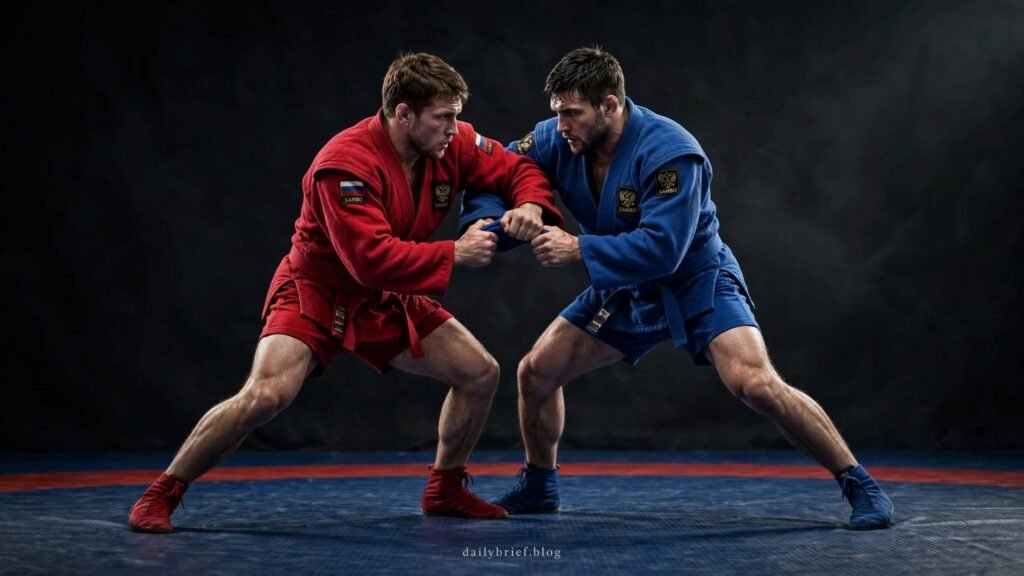
It can provide physical, technical, and mental benefits when practiced consistently in a suitable training environment.
Improves Strength and Conditioning
Training involves repeated movement, resistance, throws, technical drills, and live practice. These activities can improve muscular endurance, coordination, and overall fitness.
The precise benefits depend on training frequency, intensity, recovery, and the individual’s starting fitness level.
Develops Balance and Coordination
Throws and takedowns require athletes to recognize shifts in balance and react quickly. Regular practice can improve body awareness, timing, and movement efficiency.
These skills are useful for athletic development, although they do not guarantee an advantage in every sport or situation.
Builds Problem-Solving Skills
It requires continuous decision-making. An athlete must evaluate an opponent’s stance, identify openings, defend attacks, and adapt to changing positions.
This process encourages tactical thinking and the ability to remain focused under pressure.
Supports Practical Self-Defense Training
Sambo can teach useful unarmed skills, including balance recovery, defensive movement, controlling distance through grappling, and escaping certain positions.
However, competitive techniques are not automatically appropriate for every real-world encounter. Self-defense also requires situational awareness, de-escalation, and recognizing when escape is safer than physical confrontation.
Encourages Discipline and Confidence
Consistent training requires patience, repetition, and respect for training partners. Progress may be gradual, but learning a challenging technique or improving competition performance can help build confidence.
These benefits depend on the training culture. A responsible coach should prioritize safety, respect, and steady improvement rather than unnecessary aggression.
Is Sambo Suitable for Beginners?
Yes. Beginners can learn It without previous martial arts experience, provided they start with an appropriate class and a qualified instructor.
New students should focus on fundamental movements before attempting advanced submissions or high-intensity sparring.
A sensible starting progression includes:
- Learn the basic stance, movement, and grip positions.
- Practice safe falling and landing techniques.
- Develop balance, basic throws, and simple takedown defenses.
- Learn ground positioning and controlled escapes.
- Add permitted submission techniques gradually under supervision.
- Introduce live practice only when the coach considers the student ready.
Beginners interested in Combat Sambo should learn striking defense and grappling fundamentals progressively. Protective equipment and controlled drills are especially important when training includes strikes.
Before joining a club, ask about instructor qualifications, class structure, beginner programs, hygiene, injury procedures, and the supervision provided during sparring.
Common Mistakes to Avoid When Learning Sambo
Many beginners focus on learning impressive techniques before developing the foundation required to perform them safely and effectively.
Avoid these common mistakes:
Using strength instead of technique: Trying to overpower every opponent wastes energy and can leave you vulnerable. Work on leverage, balance, timing, and positioning.
Ignoring defensive fundamentals: Knowing how to attack is not enough. Practice safe falling, escapes, balance recovery, and defense against common attacks.
Applying submissions too aggressively: Joint locks can cause serious injuries when forced. Practice under supervision and release immediately when a partner submits.
Training without recovery: Intense grappling places stress on muscles and joints. Allow sufficient recovery and seek medical assessment for significant or persistent injuries.
Assuming every rule set is identical: Sport Sambo and Combat Sambo have different permitted techniques. Learn the regulations relevant to your training rather than mixing rules from different competitions.
Neglecting consistency: Regular, technically focused practice is generally more useful than occasional sessions driven by excessive intensity.
Frequently Asked Questions About Sambo
Is Sambo a Russian martial art?
Yes. Sambo developed in the Soviet Union during the early 20th century and is strongly associated with Russian martial arts history. It later spread internationally through clubs, federations, and competitions.
Is Sambo effective for self-defense?
Sambo can develop useful grappling, takedown defense, body control, and physical conditioning skills. Combat Sambo also includes striking. Real-world self-defense, however, involves risks and circumstances that controlled sporting matches cannot fully reproduce.
Is Sambo better than judo?
Neither is universally better. Sambo offers its own combination of throwing, grappling, and permitted submission techniques, while judo follows different competitive rules and technical priorities. Your goals and the quality of available instruction should guide your choice.
Can beginners learn Sambo?
Yes. A beginner can start with basic movement, safe falling, grip control, and fundamental throws. Advanced submissions and intense sparring should come later, with appropriate instruction and supervision.
Does Sambo include punches and kicks?
Combat Sambo permits striking under its competition rules. Standard Sport Sambo focuses on grappling and does not permit punches and kicks. Always consult the rules for the specific discipline and event.
What equipment is needed for Sambo?
Traditional training and competition gear typically includes a Sambo jacket, shorts, and specialized wrestling shoes. Combat Sambo also uses appropriate protective equipment, according to the applicable rules. Beginners should ask their club which items are required before purchasing anything.
Conclusion: Sambo Explained in Simple Terms
Sambo Explained comes down to understanding a martial art that combines technical grappling, powerful throws, takedowns, and permitted submission techniques. Developed in the Soviet Union, it has evolved into an international combat sport with distinct disciplines, including Sport Sambo, Combat Sambo, and Beach Sambo.
Its main appeal lies in its emphasis on practical movement, balance, control, and adaptability. Whether your goal is fitness, competition, martial arts experience, or learning defensive skills, Sambo offers a structured way to develop these abilities.
Start with the fundamentals, choose a reputable training club, and learn the rules of your chosen discipline. With consistent practice and a strong commitment to safety, you can build a solid foundation and understand what makes Sambo a distinctive martial art.