PepsiCo, Inc. (NASDAQ: PEP) has one of the longest and most closely followed dividend records among major consumer-staples companies. For investors researching PEP dividend history, the most important story is not simply the size of the latest payment, but the consistency of quarterly distributions and the company’s long record of annual increases.
PepsiCo says it has paid consecutive quarterly cash dividends since 1965. In 2026, the company reached its 54th consecutive annual dividend increase, raising its annualized dividend to $5.92 per share from $5.69.
This guide examines the PEP dividend history, recent payment amounts, important dividend dates, long-term growth pattern, and the factors investors should consider before relying on the stock for income.
PEP Dividend History at a Glance
| Metric | Latest Information |
|---|---|
| Stock ticker | PEP |
| Company | PepsiCo, Inc. |
| Latest quarterly dividend | $1.48 per share |
| Current annualized dividend | $5.92 per share |
| 2025 annualized dividend | $5.69 per share |
| 2026 increase | 4% |
| Payment frequency | Quarterly |
| Consecutive annual increases | 54 years |
| Consecutive quarterly payments | Since 1965 |
| Principal exchange | Nasdaq Global Select Market |
PepsiCo’s official dividend records show that the quarterly payment increased from $1.355 in early 2025 to $1.4225 later that year, before rising to $1.48 in 2026.
PEP Dividend History for 2026
The 2026 PEP dividend history shows another step higher in PepsiCo’s long-term distribution record.
The company paid or declared the following dividends during the year:
| Declaration | Dividend per Share | Record Date | Payment Date |
|---|---|---|---|
| Feb. 4, 2026 | $1.4225 | Mar. 6, 2026 | Mar. 31, 2026 |
| May 6, 2026 | $1.48 | June 5, 2026 | June 30, 2026 |
| July 17, 2026 | $1.48 | Sept. 4, 2026 | Sept. 30, 2026 |
The May 2026 increase brought the annualized dividend to $5.92 per share. PepsiCo’s July 2026 announcement confirmed another $1.48 quarterly payment and stated that the increase represented the company’s 54th consecutive annual dividend increase.
One important distinction is worth noting: annualized dividend and dividends actually received during a calendar year are not always the same thing. A dividend increase introduced during the year can affect the following quarters without changing all four payments made in that calendar year.
PEP Dividend History: Recent Annual Changes
Looking at several years together makes the trend easier to understand.
| Year | Representative Quarterly Dividend | Annualized Rate |
|---|---|---|
| 2022 | $1.15 | $4.60 |
| 2023 | $1.265 | $5.06 |
| 2024 | $1.355 | $5.42 |
| 2025 | $1.4225 | $5.69 |
| 2026 | $1.48 | $5.92 |
The table highlights a broader upward pattern. PepsiCo increased its quarterly dividend from $1.15 in early 2022 to $1.48 in 2026, while the annualized rate moved from approximately $4.60 to $5.92.
The official dividend database provides a much longer record, extending back decades and showing regular increases over time.
How Often Does PEP Pay a Dividend?
PepsiCo normally pays dividends four times a year.
Historically, the company has paid its quarterly dividends around January, March, June, and September, although the declaration and payment schedule can vary slightly from year to year. PepsiCo’s shareholder-services information confirms the quarterly structure.
For an investor, the key dates are:
- Declaration date — when PepsiCo’s board announces the dividend.
- Ex-dividend date — the date used to determine whether a new buyer qualifies for the upcoming distribution.
- Record date — the date PepsiCo uses to identify eligible shareholders.
- Payment date — when the dividend is actually distributed.
These dates should not be confused. A stock’s dividend announcement does not mean investors can buy the shares at any time afterward and automatically receive that payment.
PEP Dividend History and Long-Term Dividend Growth
The strongest feature of PEP dividend history is its longevity.
PepsiCo reports that it has paid consecutive quarterly cash dividends since 1965. More recently, the company reached 54 consecutive years of annual dividend increases in 2026.
That record places PepsiCo among a relatively select group of companies with exceptionally long dividend-growth histories.
However, a long dividend record should be viewed as evidence of historical consistency—not a guarantee of future increases. Dividends are ultimately determined by the company’s board and depend on financial performance, cash generation, capital allocation priorities, and business conditions.
What Caused the Latest PEP Dividend Increase?
The latest increase was announced as part of PepsiCo’s ongoing shareholder-return strategy.
In 2026, PepsiCo raised its annualized dividend by 4%, from $5.69 to $5.92 per share. The company said the increase was effective with the dividend expected to be paid in June 2026.
PepsiCo’s management also projected approximately $8.9 billion in total cash returns to shareholders for 2026, including roughly $7.9 billion in cash dividends and $1 billion in share repurchases.
This is important because dividend investors should look beyond the payment itself. The sustainability of a dividend depends on how comfortably the underlying business can fund distributions while still investing in operations, reducing debt, pursuing acquisitions, and maintaining financial flexibility.
PEP Dividend History vs. Dividend Yield
A common mistake is to look at PEP dividend history and assume that a rising dividend automatically means an attractive yield.
Dividend yield depends on both the dividend and the share price:
Dividend Yield = Annual Dividend ÷ Stock Price × 100
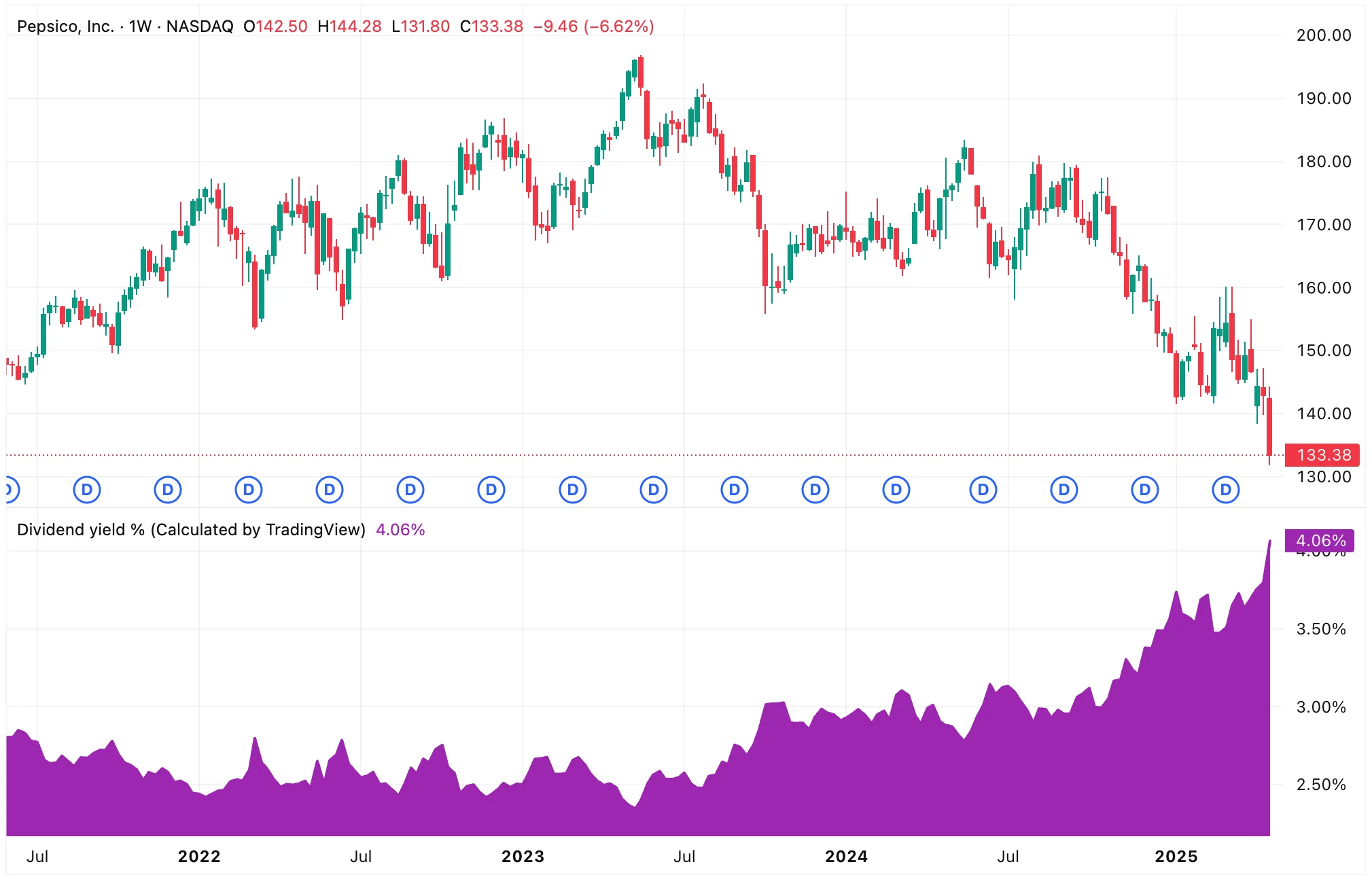
For example, a $5.92 annualized dividend would produce a 4% yield if the stock were priced at $148. But if the share price rose substantially, the yield would fall even if PepsiCo continued increasing its dividend.
Conversely, a declining stock price can push the yield higher without any increase in the underlying dividend.
This is why income investors should analyze both dividend growth and valuation rather than focusing on yield alone.
Why Investors Study PEP Dividend History
There are several reasons the historical record matters.
1. It Shows Management’s Dividend Priorities
A multi-decade record of regular payments indicates that returning cash to shareholders has been an important part of PepsiCo’s capital-allocation strategy.
2. It Helps Evaluate Income Growth
Investors who rely on dividends often care about future income growth, not just today’s yield. A growing per-share dividend can potentially increase income without requiring an investor to purchase additional shares.
3. It Provides Historical Context
Looking at several decades of payments can reveal whether increases have generally been consistent or whether the company has experienced prolonged periods of stagnation.
4. It Helps With Portfolio Planning
Investors building an income-oriented portfolio can use dividend history alongside payout ratios, earnings growth, cash flow, debt levels, and valuation to determine how a stock fits within their broader strategy.
Important Dates in the PEP Dividend History
For investors tracking PEP dividend history, PepsiCo’s official dividend page is the most useful starting point because it lists declared amounts, record dates, payment dates, and dividend types.
For example, PepsiCo’s 2026 schedule shows a $1.48 dividend with a June 5 record date and June 30 payment date, followed by another $1.48 dividend with a September 4 record date and September 30 payment date.
Investors should always check the latest company announcement before making a purchase specifically to qualify for a dividend.
Does PepsiCo Have a Reliable Dividend?
Historically, PepsiCo has demonstrated a high level of dividend consistency. Its quarterly payments since 1965 and 54 consecutive annual increases through 2026 are particularly notable.
Still, “reliable” does not mean risk-free.
PepsiCo operates a large global food and beverage business and faces risks including changing consumer preferences, commodity costs, currency movements, inflation, competition, regulation, and broader economic conditions.
For this reason, investors should evaluate the dividend together with the company’s earnings, free cash flow, debt obligations, valuation, and future growth prospects.
PEP Dividend History: What Investors Should Watch Next
The next chapter of PEP dividend history will depend on PepsiCo’s ability to balance shareholder distributions with reinvestment in the business.
Management has indicated that improving organic revenue growth and operating margins are important priorities. The company has also discussed improving free-cash-flow conversion, with a 2027 goal of exceeding 90%.
For dividend investors, several indicators deserve attention:
- Free cash flow: Can the business continue funding dividends comfortably?
- Earnings growth: Are profits growing enough to support future increases?
- Payout ratio: Is the dividend consuming a reasonable portion of earnings and cash flow?
- Debt: Is leverage limiting financial flexibility?
- Dividend growth rate: Are annual increases keeping pace with inflation?
- Valuation: Is the stock price reasonable relative to the company’s fundamentals?
These factors provide more insight than dividend yield alone.
Common Mistakes When Researching PEP Dividend History
Mistake 1: Confusing Declaration and Payment Dates
A dividend announced in one month may be paid several weeks later. Always distinguish between the declaration, record, ex-dividend, and payment dates.
Mistake 2: Treating Annualized Dividends as Calendar-Year Payments
If PepsiCo raises its dividend halfway through a year, the four payments received during that calendar year may not equal the new annualized rate.
Mistake 3: Looking Only at Yield
A high yield can sometimes result from a falling share price rather than stronger dividend fundamentals.
Mistake 4: Assuming Past Increases Are Guaranteed
PepsiCo’s historical record is impressive, but future dividends remain subject to board approval and the company’s financial position.
Mistake 5: Ignoring Total Return
Dividend income is only one component of an investment’s return. Share-price performance, reinvested dividends, taxes, and valuation can all materially affect an investor’s outcome.
How to Use PEP Dividend History as an Investor
The best way to use PEP dividend history is as one part of a broader investment analysis.
Start by establishing the current annualized dividend and payment schedule. Then examine the historical growth rate, payout sustainability, earnings trends, free cash flow, debt, and valuation.
Finally, consider whether PepsiCo’s dividend characteristics match your investment objective. A long history of increases may appeal to investors seeking growing income, while other investors may prioritize faster earnings growth, lower valuation, or higher current yield.
PepsiCo’s official investor-relations resources provide the company’s dividend history, annual reports, earnings information, and shareholder materials, making them valuable primary sources for ongoing research.
Frequently Asked Questions About PEP Dividend History
What is PepsiCo’s current dividend?
As of 2026, PepsiCo’s quarterly dividend is $1.48 per share, equivalent to an annualized dividend of $5.92 per share.
How often does PepsiCo pay dividends?
PepsiCo generally pays dividends quarterly. Its shareholder information states that dividends have historically been paid in January, March, June, and September.
How long has PepsiCo paid dividends?
PepsiCo has paid consecutive quarterly cash dividends since 1965.
How many consecutive years has PepsiCo increased its dividend?
PepsiCo reached 54 consecutive annual dividend increases in 2026.
Has PepsiCo increased its dividend recently?
Yes. In 2026, PepsiCo increased its annualized dividend by 4%, from $5.69 to $5.92 per share.
Where can I find the official PEP dividend history?
PepsiCo publishes its official dividend information, including declared amounts, record dates, and payment dates, on its investor-relations website.
Final Takeaway
The long-term PEP dividend history shows a company with an unusually consistent record of shareholder distributions. PepsiCo has maintained quarterly cash dividends since 1965 and delivered its 54th consecutive annual increase in 2026, when the annualized dividend rose to $5.92 per share.
For investors, however, the history is only the starting point. The more important question is whether future earnings and cash generation can support continued dividend growth at an attractive valuation.
By combining PepsiCo’s dividend record with free cash flow, payout sustainability, financial strength, business performance, and the current share price, investors can make a more informed assessment of what PEP’s dividend may mean for their portfolio.