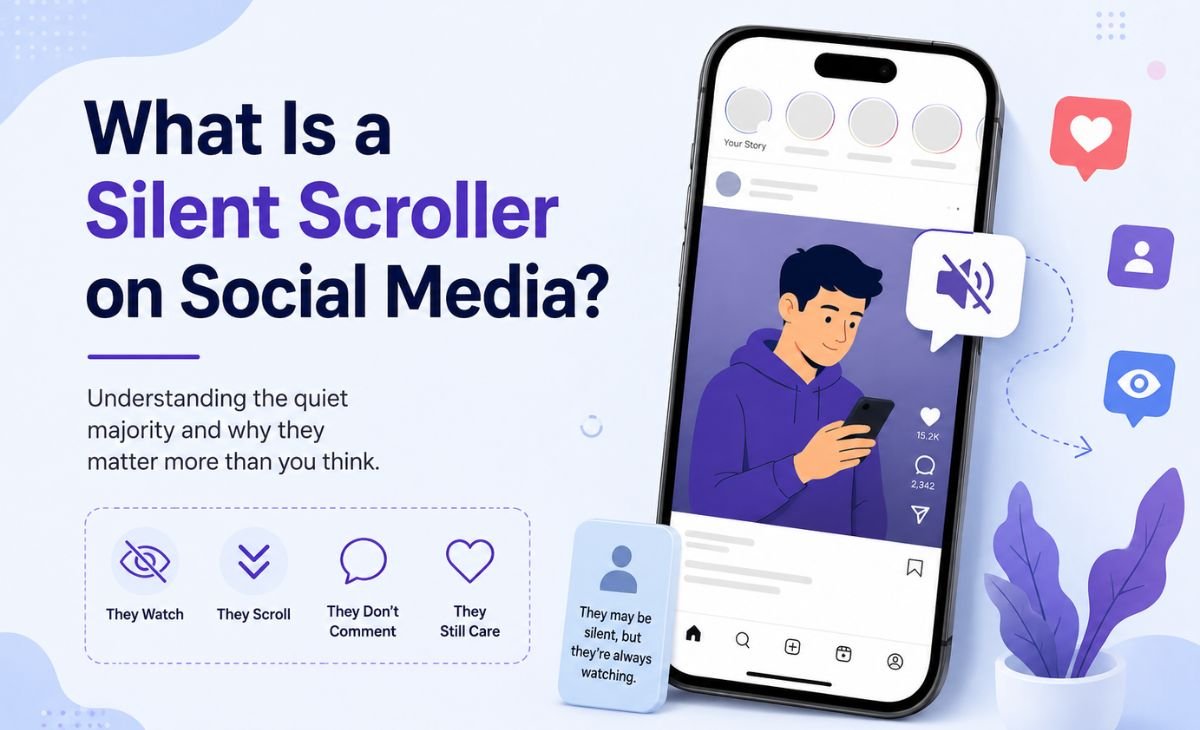
If you post on social platforms and notice people regularly viewing your content without liking, commenting, or sharing, you may be observing a growing online behavior. Understanding social media silent scrollers traits can help creators, marketers, businesses, and everyday users interpret engagement more accurately.
Silent scrollers are not necessarily uninterested. Many actively consume posts, watch videos, read captions, compare products, learn from creators, or follow conversations without leaving a visible reaction. Their behavior reveals an important distinction between attention and engagement.
This guide explores the most common social media silent scrollers traits, why people scroll quietly, how to recognize them, and what creators can do to turn passive attention into meaningful interaction.
What Are Silent Scrollers on Social Media?
Silent scrollers are social media users who consume content without frequently interacting with it publicly. They may watch Instagram Reels, read Facebook posts, browse TikTok videos, view LinkedIn updates, or follow stories while rarely pressing like, comment, repost, or share.
They are sometimes described as lurkers, passive consumers, or invisible audiences. However, these labels can be misleading because silence does not automatically mean disinterest.
A person can be highly interested in your content while remaining completely invisible in your public engagement metrics.
Quick Facts About Silent Scrollers
| Behavior | What It Can Indicate |
|---|---|
| Watches videos but rarely likes | Private consumption preference |
| Reads posts without commenting | Interest without desire to participate |
| Saves useful content | Stronger intent than a simple like |
| Regularly views Stories | Consistent attention |
| Shares privately | Interest that isn’t visible publicly |
| Follows but rarely interacts | Long-term passive interest |
| Returns to similar content | Topic relevance |
The key lesson is simple: visible engagement is not the same as total attention.
15 Social Media Silent Scrollers Traits You Should Know
1. They Consume More Than They Communicate
One of the clearest social media silent scrollers traits is a large gap between consumption and interaction.
These users might watch dozens of videos, read several posts, and spend considerable time on a platform without producing a single public reaction.
They are observers first and participants second.
2. They Prefer Privacy
Some people simply do not enjoy broadcasting their opinions online.
They may avoid comments because they don’t want their name attached to a particular viewpoint, don’t want to start arguments, or prefer keeping their interests private.
For these users, scrolling is comfortable because it provides information without requiring social exposure.
3. They Are Often Highly Selective
Silent users don’t necessarily ignore everything. In many cases, they carefully choose when to interact.
They may only like content they genuinely love, comment when they have something meaningful to contribute, or share something when it provides obvious value.
As a result, a low interaction rate doesn’t necessarily represent low content quality.
4. They Observe Before Acting
Another important trait is cautious decision-making.
A silent follower might watch your content for weeks before subscribing, purchasing something, joining your community, or sending a message.
This is particularly important for businesses. A potential customer can consume substantial amounts of content before making themselves known.
5. They Use Social Media for Information
Not everyone opens social media to socialize.
Many people use platforms as personalized information feeds. They follow experts, brands, educators, journalists, entertainers, or niche communities because they want convenient access to information.
They don’t necessarily feel the need to comment every time they learn something useful.
6. They Save Content Instead of Liking It
Saving is an especially valuable behavior because it can happen without public interaction.
Someone might save a recipe, marketing tip, workout tutorial, travel recommendation, product review, or educational post with the intention of returning later.
For creators, saves can therefore reveal stronger practical interest than visible likes alone.
7. They Watch Stories Without Responding
Regular Story viewers are another group worth examining.
A follower may consistently watch your Stories while never sending a reaction or replying. Their repeated viewing suggests that your content remains relevant enough to earn their attention.
This is one of the more overlooked social media silent scrollers traits because Story consumption can be easy to confuse with inactivity.
8. They Research Before Buying
Silent scrolling is especially common during purchasing decisions.
A user may follow a brand, examine product demonstrations, read comments, watch testimonials, and compare alternatives without ever publicly interacting with the company.
Eventually, they may visit the website or make a purchase.
This means social media can influence conversions even when the path from content exposure to purchase isn’t obvious.
9. They Avoid Online Arguments
Some people deliberately minimize interaction because social platforms can become confrontational.
Rather than debating strangers, they read discussions and move on.
This behavior is particularly common around controversial subjects, where commenting can attract unwanted attention or prolonged arguments.
10. They May Be Introverted or Socially Reserved
Personality can influence online behavior, but it should not be used to diagnose individuals.
Some socially reserved users simply feel more comfortable observing than participating. Others may be extremely outgoing offline but quiet online.
Therefore, social media silent scrollers traits should be viewed as behavioral patterns rather than personality labels.
11. They Don’t Need Social Validation
Likes and comments can provide social validation, but not everyone cares about receiving or giving it.
Some users approach social platforms almost like television: they watch what interests them and continue scrolling.
Their lack of interaction isn’t necessarily a judgment against the creator.
12. They Multitask While Scrolling
Another overlooked factor is attention quality.
People frequently scroll while commuting, waiting in line, watching television, eating, or taking short breaks. They may consume content without having enough attention or motivation to respond.
This helps explain why someone can repeatedly see your posts without generating measurable engagement.
13. They Engage Privately
Public metrics don’t capture every form of interaction.
Silent users may send a post directly to a friend, discuss it in a private group, bookmark it, search for the creator later, or use the information offline.
These behaviors can be commercially and socially meaningful even though they aren’t always visible to the original poster.
14. They Become Active When Content Feels Personally Relevant
A quiet follower may suddenly comment when you publish something that directly addresses their needs.
For example, a person who never interacts with general marketing posts might respond to a detailed tutorial solving a problem they currently have.
This is why relevance often matters more than simply increasing posting frequency.
15. They Can Be Loyal Without Being Loud
Perhaps the most important of the social media silent scrollers traits is quiet loyalty.
Someone doesn’t need to comment every day to value a creator or brand. They may consistently consume content for months, recommend it privately, or eventually become a customer.
In other words, the loudest followers aren’t necessarily the most valuable followers.
Why Do People Scroll Without Engaging?
There is no single explanation for silent consumption.
Common reasons include:
- They don’t know what to say.
- They prefer privacy.
- They are consuming content casually.
- They don’t want public attention.
- They are short on time.
- They find the content useful but don’t feel commenting is necessary.
- They are researching a purchase.
- They dislike online debates.
- They are waiting until they trust the creator.
- They simply have different engagement habits.
Platform design also matters. Infinite scrolling makes consumption extremely easy, while commenting requires an additional decision and effort.
Silent Scrollers vs. Active Engagers
Understanding the difference helps prevent inaccurate conclusions about your audience.
| Silent Scrollers | Active Engagers |
|---|---|
| Primarily observe | Frequently participate |
| Rarely comment | Regularly comment |
| May save content privately | Often share publicly |
| Can influence themselves quietly | Signal interest visibly |
| May convert later | May convert sooner |
| Difficult to identify individually | Easy to measure through interactions |
Neither group is automatically better.
Active followers provide visible social proof, while silent followers can represent a substantial pool of attention that conventional engagement metrics don’t fully reveal.
How Creators Can Engage Silent Scrollers
If your audience contains many quiet consumers, don’t try to force them into commenting.
Instead, make interaction easy and useful.
Ask Low-Effort Questions
Instead of asking, “What are your thoughts on this complicated topic?” try simple prompts such as:
- “Which option would you choose?”
- “Have you tried this?”
- “A or B?”
- “Want part two?”
- “Should I make a tutorial?”
Simple questions reduce the psychological effort required to respond.
Create Save-Worthy Content
Tutorials, checklists, templates, comparisons, examples, and concise educational posts often provide reasons to save content.
A useful post can generate value even when nobody comments.
Build Trust Consistently
Silent users may be evaluating your credibility.
Consistent publishing, accurate information, transparent recommendations, and useful explanations can gradually move passive viewers toward active participation.
Give People a Reason to Respond
A generic “Let me know what you think” isn’t always compelling.
Instead, give users a specific reason to participate. Ask for an experience, preference, prediction, question, or choice.
What Silent Scrolling Means for Businesses
Businesses should be especially careful when interpreting engagement rates.
A campaign with modest likes can still influence purchasing decisions if the content reaches people who are actively researching a product or service.
For this reason, companies should examine metrics beyond public interactions, including:
- Website traffic
- Search activity
- Saves
- Direct messages
- Profile visits
- Link clicks
- Leads
- Conversions
- Returning visitors
- Customer surveys
The strongest social media silent scrollers traits often become visible indirectly through these behaviors rather than through comments.
Common Mistakes When Analyzing Silent Scrollers
Mistake 1: Assuming Silence Means Disinterest
A person who doesn’t comment may still be paying close attention.
Treating every silent follower as uninterested can cause marketers to abandon audiences that are actually valuable.
Mistake 2: Chasing Likes at All Costs
Optimizing every post for likes can encourage shallow content.
Instead, determine what outcome matters most: awareness, education, leads, sales, community building, or retention.
Mistake 3: Over-Personalizing Audience Behavior
Don’t assume every silent follower is shy, introverted, anxious, or uninterested in social interaction.
The same behavior can have completely different causes.
Mistake 4: Ignoring Private Sharing
Public engagement is only one part of social distribution.
Private messages, group sharing, saved posts, and word-of-mouth recommendations may be impossible to see from standard public metrics.
How to Measure a Quiet Audience More Effectively
Instead of asking, “Why aren’t people commenting?” ask a broader question:
“Are people taking valuable actions after seeing my content?”
Look at trends across several metrics rather than relying on a single engagement number.
For example, if likes remain flat but profile visits, website traffic, saves, and conversions increase, your content may be performing better than the visible engagement suggests.
This is where understanding social media silent scrollers traits becomes strategically useful rather than merely interesting.
Are Silent Scrollers Bad for Social Media Growth?
Not necessarily.
Every audience contains different participation levels. A healthy community can include highly active commenters, occasional participants, private sharers, customers who never interact, and people who simply consume content.
The goal isn’t to make every follower vocal.
The goal is to create content that serves different types of users while giving interested people easy opportunities to take the next step.
Final Takeaway
The most useful way to understand social media silent scrollers traits is to stop treating silence as a lack of interest.
Quiet users may be learning, researching, comparing, saving, privately sharing, or building trust before taking visible action. Some may never become public participants—and that’s perfectly normal.
For creators and businesses, the smarter strategy is to measure the entire customer or audience journey instead of judging content exclusively by likes and comments.
When you recognize social media silent scrollers traits, you gain a more realistic picture of how people actually consume digital content. Sometimes the audience paying the closest attention is the one making the least noise.